
What makes AI recommend a clinic
We studied 116 independent physiotherapy, osteopathy and chiropractic clinics in the UK, Australia and Canada. We read about 2,800 AI answers and ran about 900 local Google searches. Here’s what made the difference, what didn’t, and what we’re still testing.
By Tor Davies, former physiotherapist and founder of Co-Kinetic · Updated November 2026
The short version
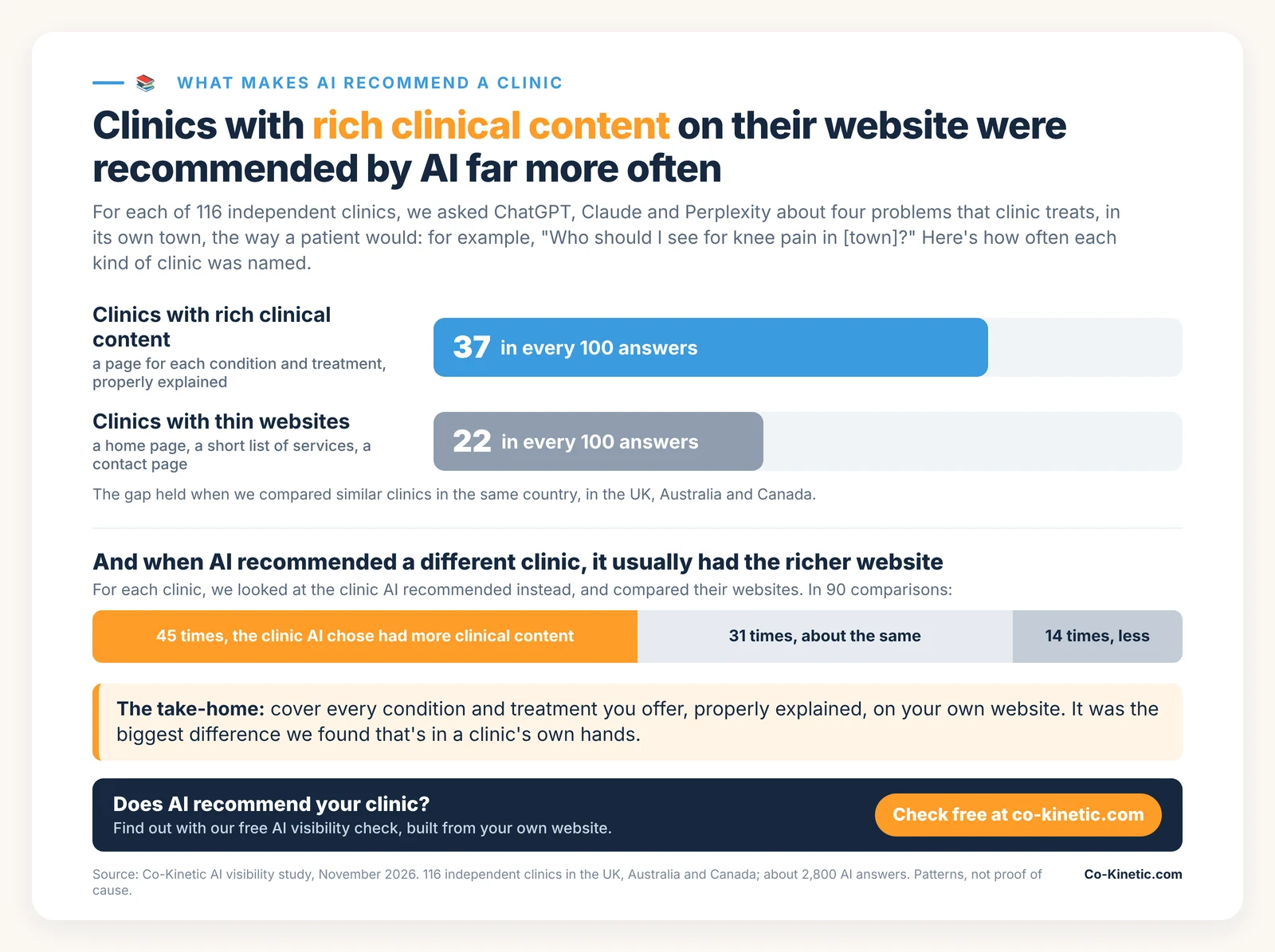
- Rich clinical content made the biggest difference of anything a clinic can change: 37% of answers against 22% for thin websites.
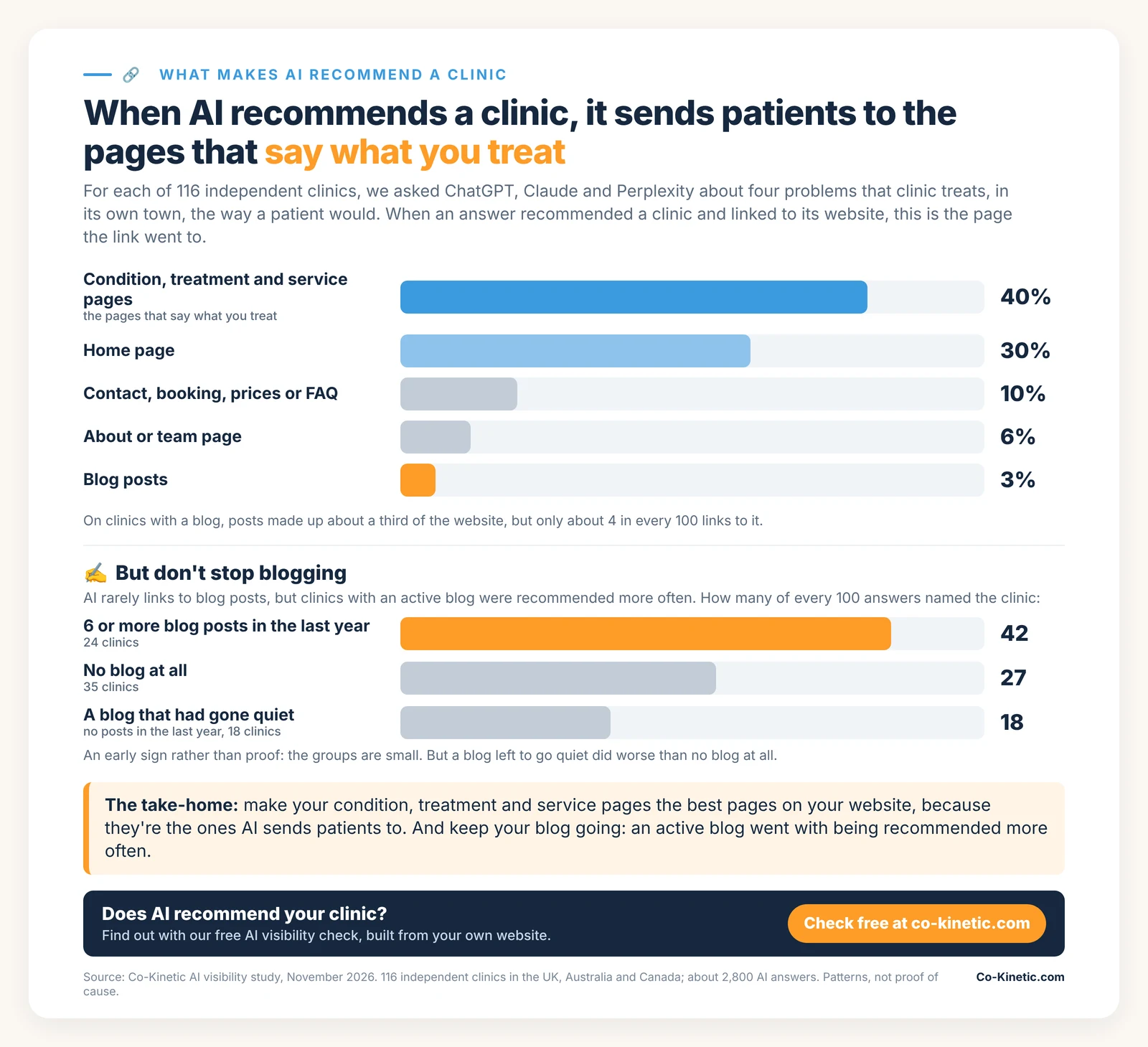
- AI sends patients to the pages that say what you treat: condition, treatment and service pages took about 40% of the links.
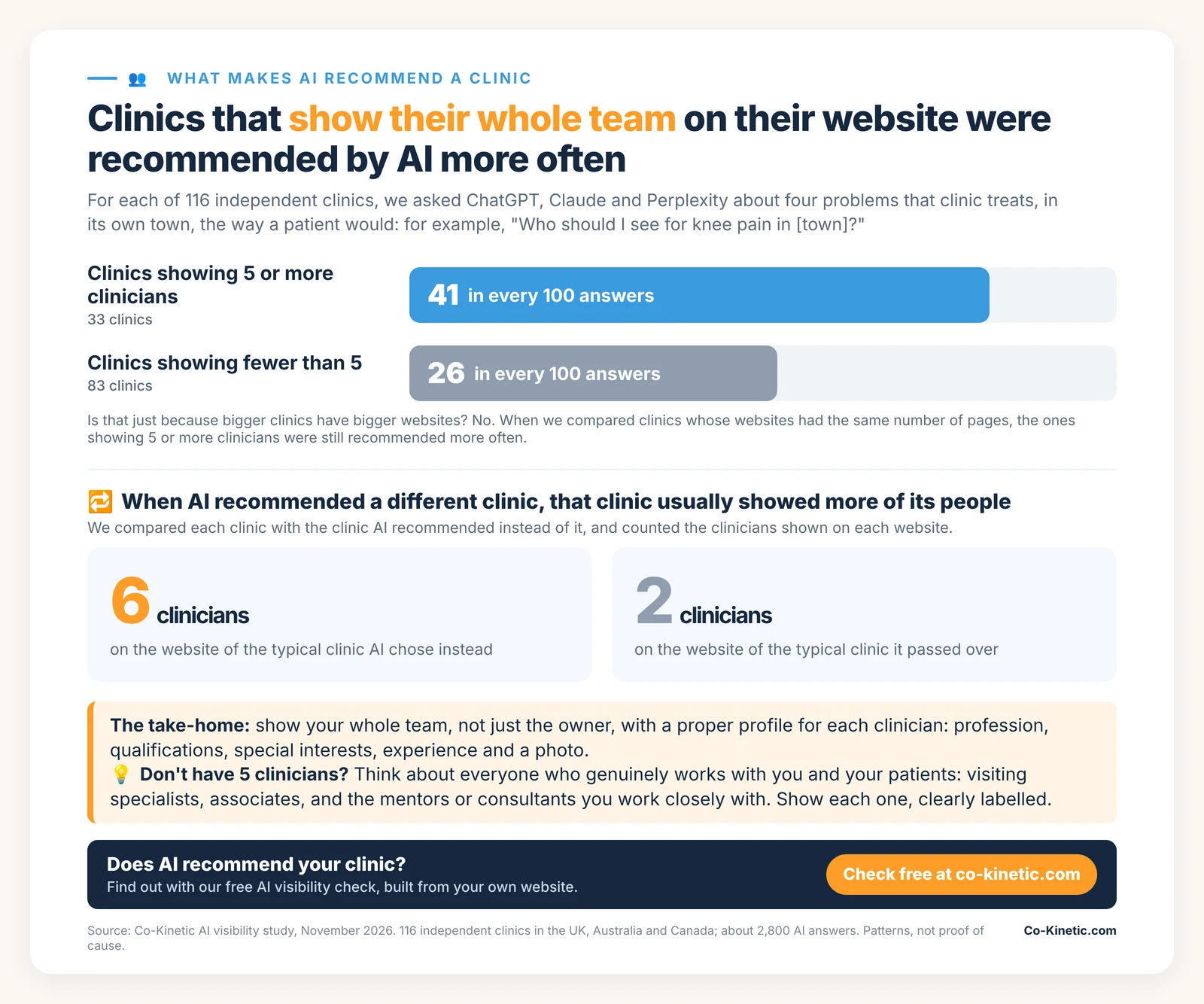
- Showing your team helps: clinics showing 5 or more practitioners were named in 41% of answers, against 26%.
- The AI tools read different things. ChatGPT and Google’s AI lean on local signals; Claude and Perplexity read your website. You need both.
- Specialist problems are easier to win, and clinics in small towns were named far more often.
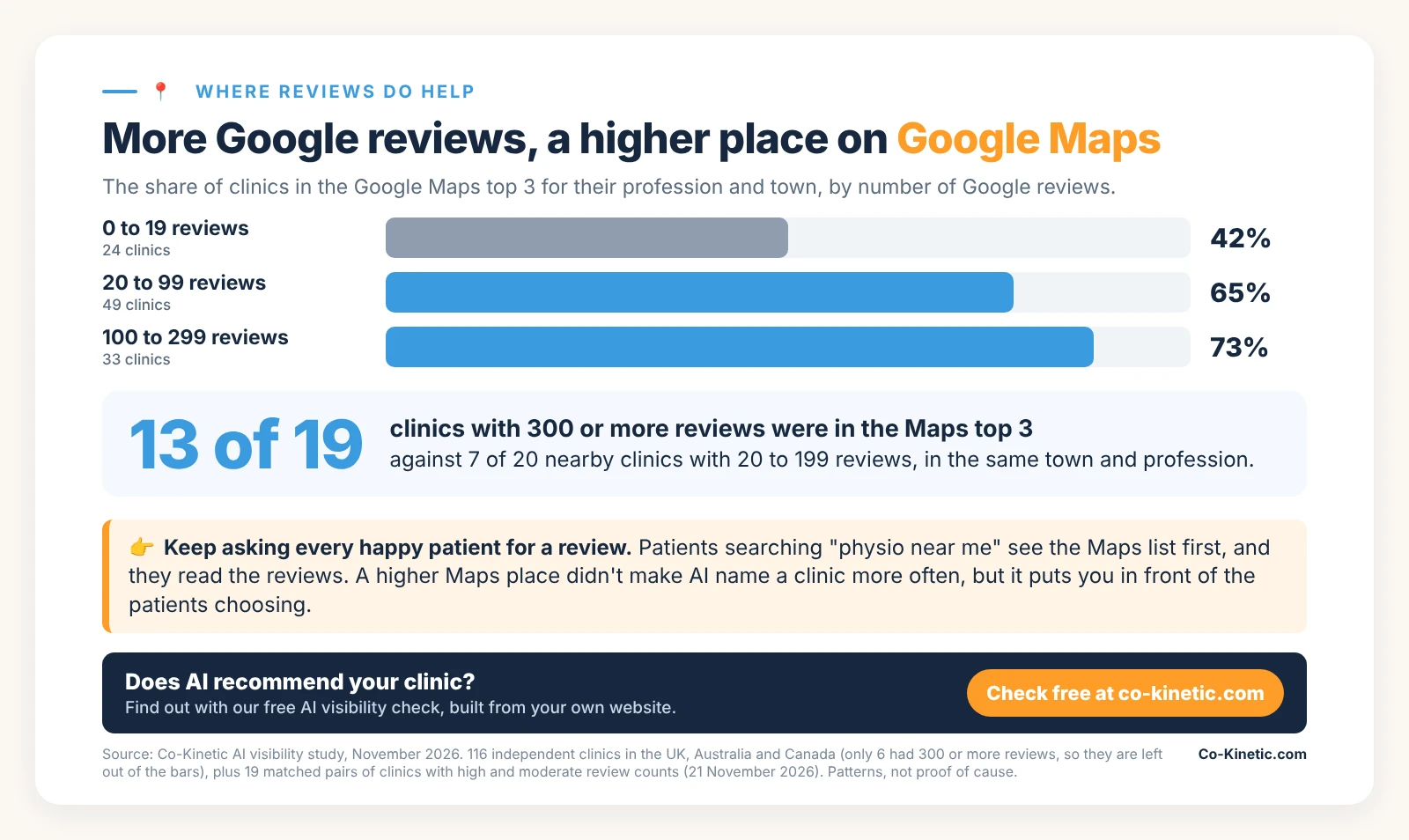
- Google reviews made no difference to whether AI named a clinic, but they lift you on Google Maps, and patients choose on them.
Every figure is the share of local “who should I see?” answers that named the clinic: 37% means 37 answers in every 100. We compared like with like: clinics of a similar kind, in the same country. These are patterns, not proof that one thing causes another.
1Rich clinical content was the biggest thing a clinic can change
Clinics with rich clinical content on their website were named in 37% of answers. Clinics with thin websites were named in 22%. It held in all three countries, and when we compared each clinic with the one AI recommended instead, the other clinic had the richer website in 45 pairs and the poorer one in only 14.
Rich content meant a page for each condition, treatment and service, each one properly explained, with the clinic’s own approach and its clinicians’ expertise coming through. More pages and longer pages didn’t help on their own: it’s depth across the whole site that counts.
2AI sends patients to the pages that say what you treat
When AI linked to a clinic’s website, about 40% of the links went to condition, treatment and service pages, and about 30% to the home page. Blog posts took only about 3%, but don’t stop blogging: clinics that published 6 or more posts in a year were named in 42% of answers, against 27% with no blog and 18% where the blog had gone quiet.
3Show your team
Clinics showing 5 or more practitioners on their website were named in 41% of answers, against 26%, even comparing websites of the same size. The clinic AI recommended instead typically showed 6 clinicians, against 2 for the clinic it passed over.
4Four AI tools, two kinds of reader
When ChatGPT recommended a clinic, it linked to the clinic’s Google Maps listing 71% of the time and its website only 15%. Claude and Perplexity did the opposite, linking to the clinic’s own website more than 8 times in 10. Google’s AI leaned on local signals: being in the Google Maps list and other websites that mention the clinic.
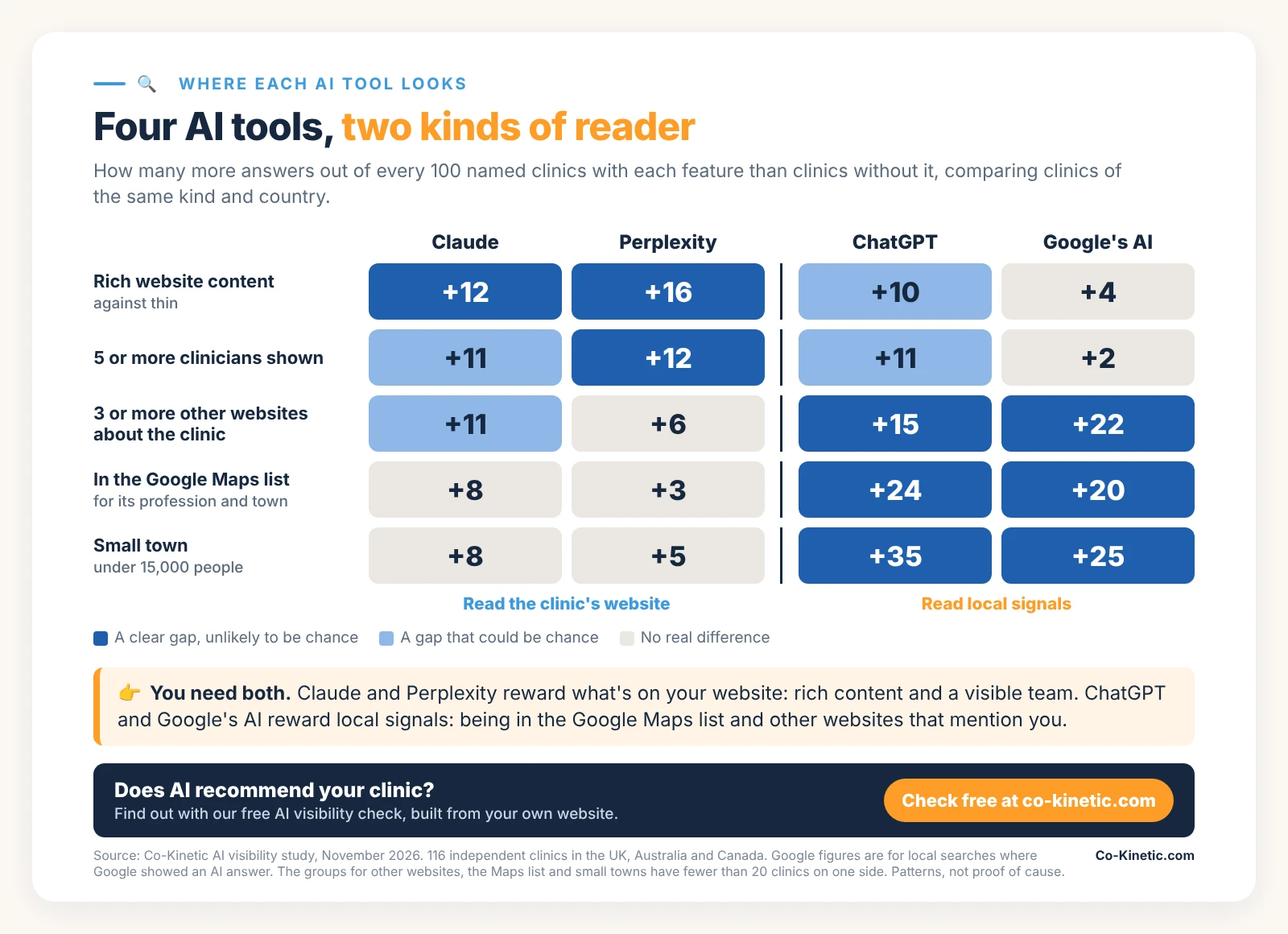
You need both: a complete, accurate Google Business Profile, and a website that explains what you treat, in depth.
5Specialist problems are easier to win
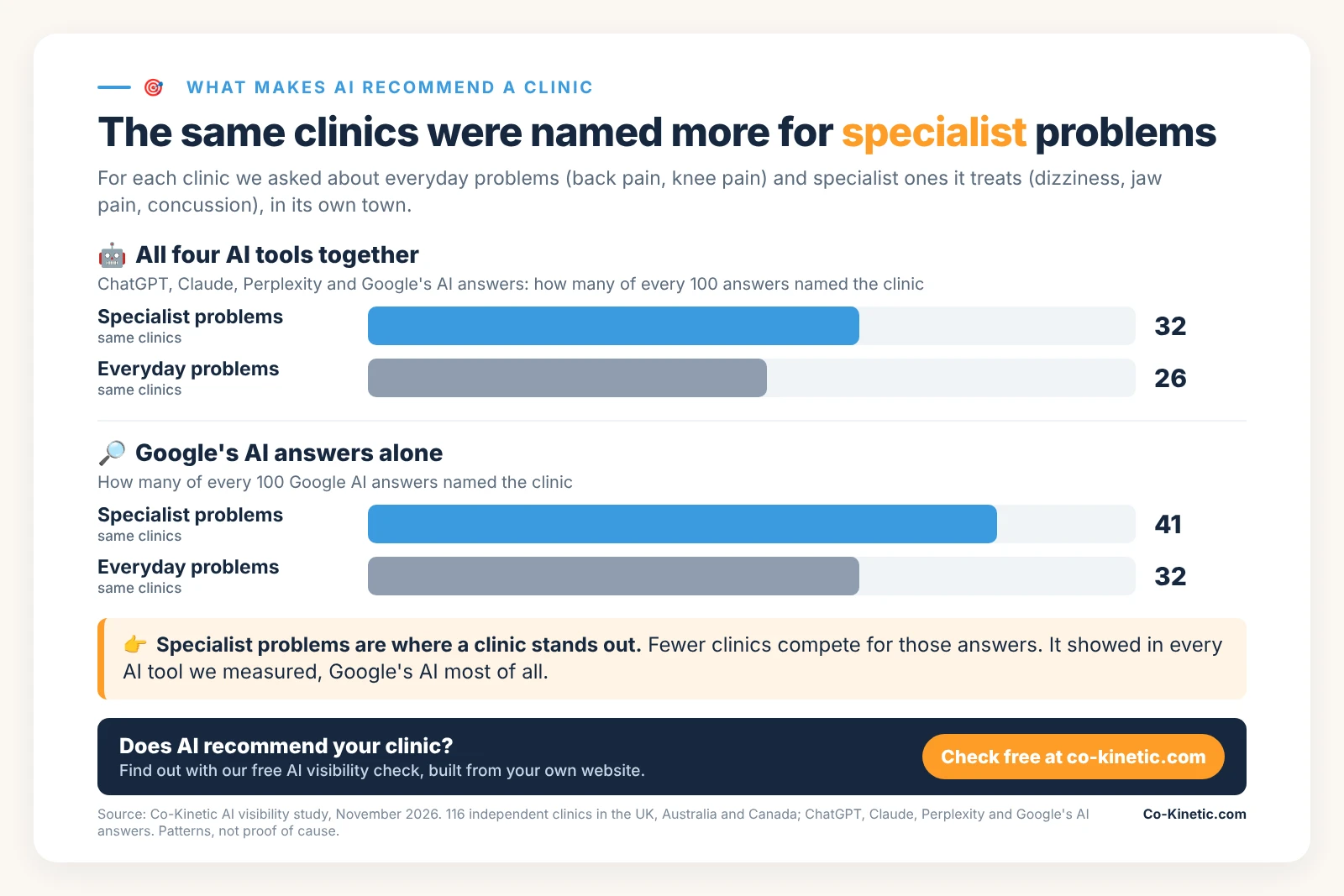
For each clinic, our check picked four problems from the clinic’s own website. Some were everyday problems that most clinics treat: back pain, neck pain, knee pain, sports injuries. Others were specialist problems that fewer clinics treat: dizziness and vertigo, jaw (TMJ) pain, pelvic pain in pregnancy, concussion, scoliosis.
Counting all four AI tools, the same clinics were named in 32% of answers for specialist problems, against 26% for everyday ones. Fewer clinics compete for those answers. Google’s AI showed it most clearly of all: 41% against 32%.
But only when the website backs it up. A speciality made a big difference for clinics with rich clinical content, and none at all for clinics with thin websites:
| Rich clinical content | Thin website | |
|---|---|---|
| Clinic with a speciality (for example running injuries or pelvic health) | 46% | 23% |
| General clinic | 32% | 23% |
The groups are small (18 clinics with a speciality and rich content), so treat this as a strong hint rather than proof.
Saying you specialise isn’t enough; writing about it properly is what counts. Most clinics have more specialist expertise than their website shows: the physio with a vestibular qualification, the one who works with a running club, the one with a pelvic health interest. Every special interest is a specialist problem you could have an in-depth page about.
6Where you are matters more than you’d think
Clinics in towns of under 15,000 people were named in 48% of answers, against 26% elsewhere: there’s simply less competition. The small-town lead showed in every AI tool, ChatGPT and Google’s AI most of all. Only 19 clinics were in towns this small, so treat it as a strong hint rather than proof.
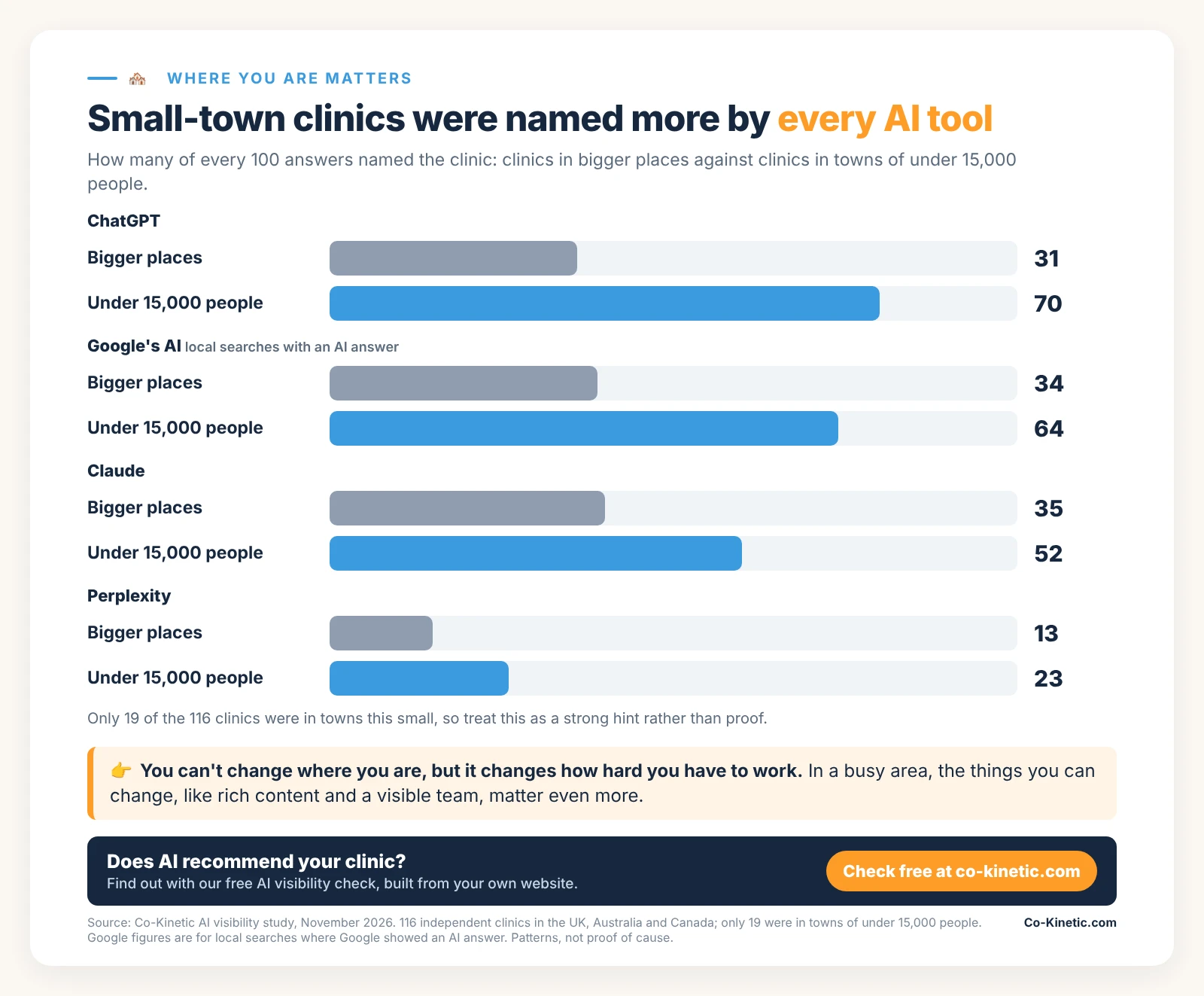
You can’t change where you are, but it changes how hard you have to work. In a busy area, rich content matters even more: thin websites there were named in 19% of answers, websites with rich clinical content in 36%.
7Google’s own AI answers
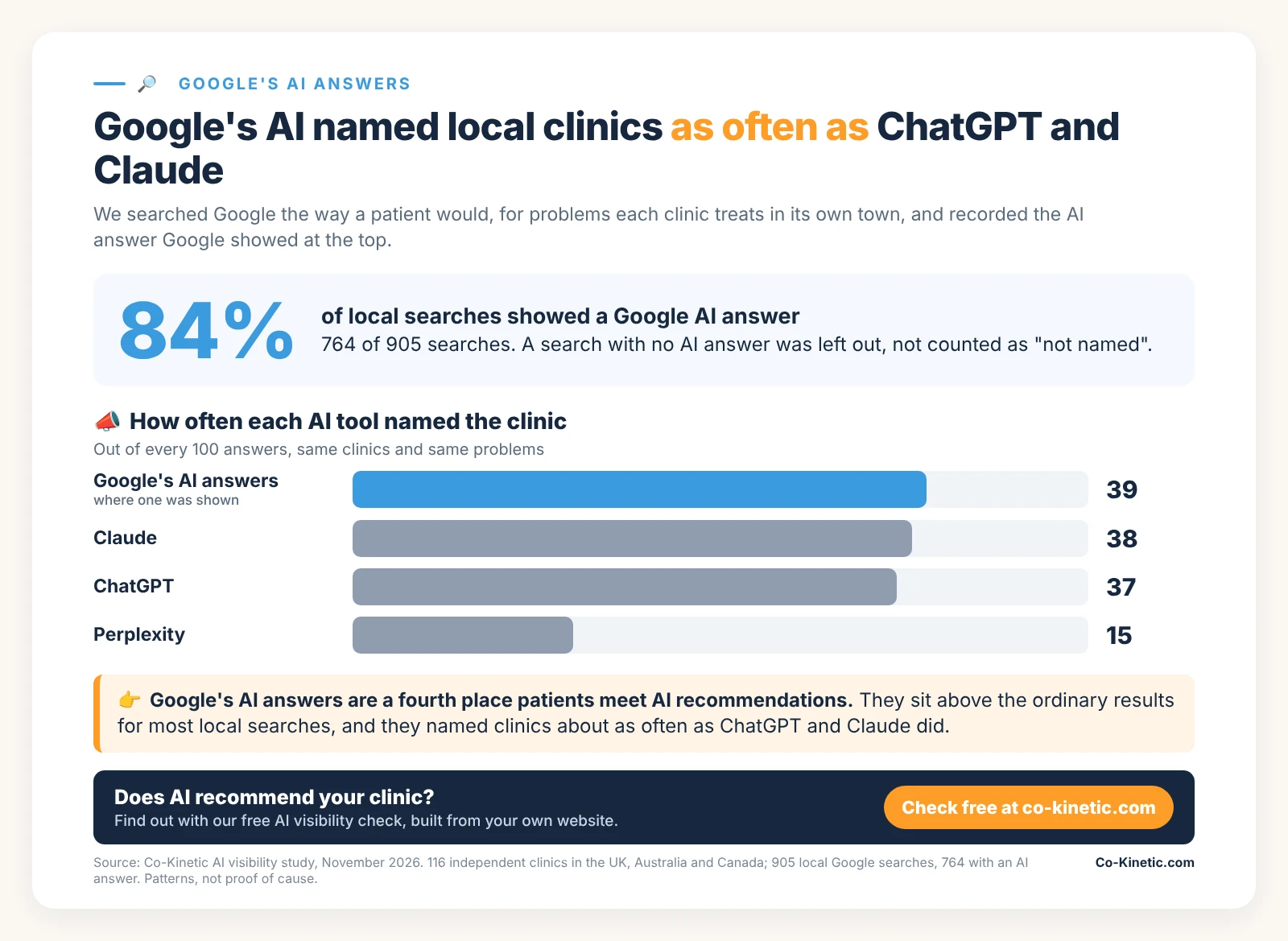
Google showed an AI answer at the top of 84% of the local searches we ran. Where it did, it named the clinic 39% of the time: about the same as ChatGPT and Claude, and well ahead of Perplexity. Many patients now see that answer before any link.
8What made no difference, and where reviews do help
Google reviews made no difference to whether AI named a clinic: not to ChatGPT, Claude or Perplexity, and in Google’s own AI, 19 clinics with 300 or more reviews were named no more often than nearby clinics with 20 to 199. More pages, longer pages, a Facebook page and an llms.txt file made no difference either.
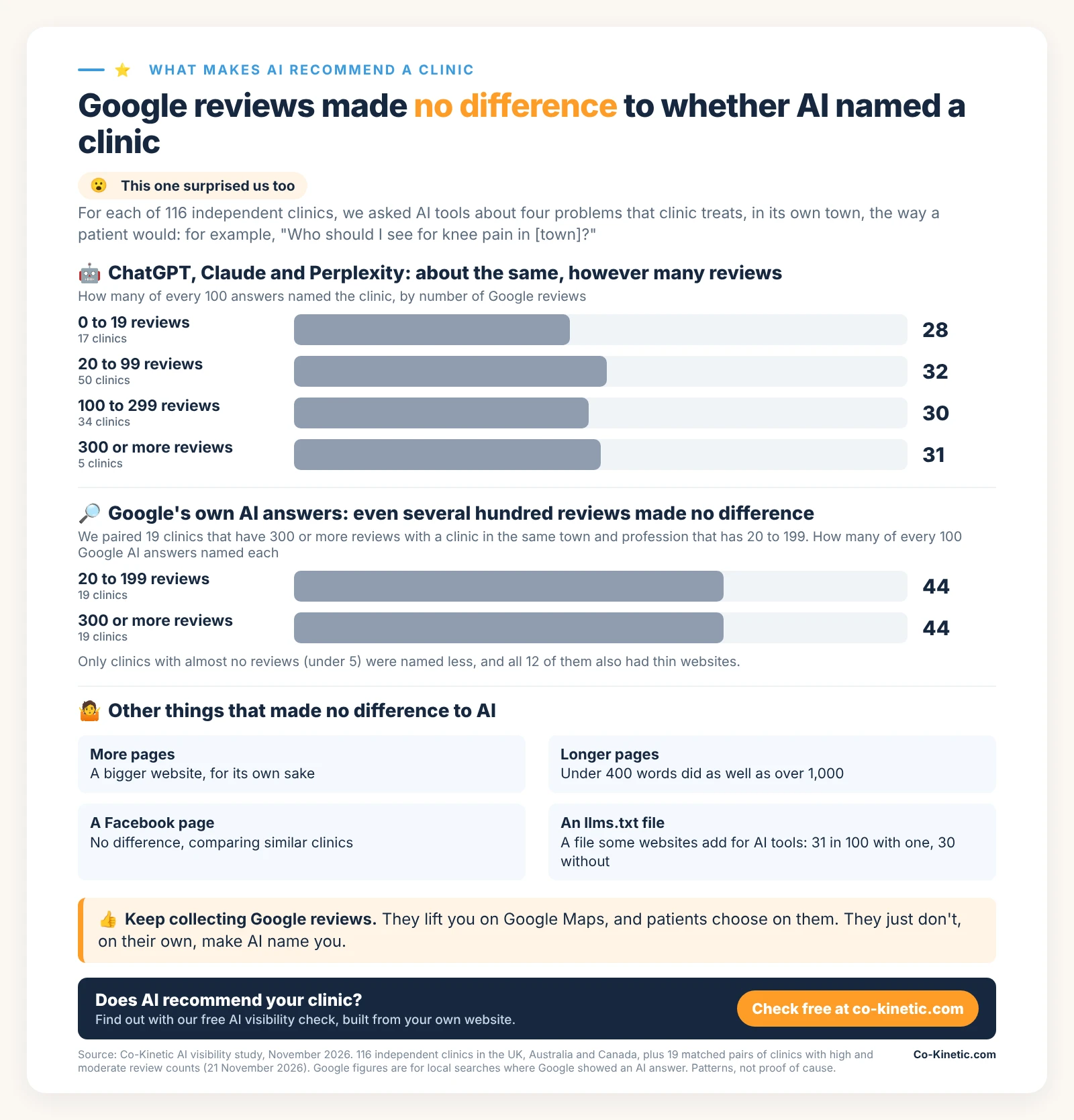
Reviews didn’t change whether AI named a clinic, but they matter in two other big ways. They lift you on Google Maps, which is the first thing patients searching “physio near me” see. And patients choose on them: faced with a clinic with 350 reviews and one with 20, most will pick the first. So keep asking every happy patient for a review, however many you already have.
How we did it
Questions built for each clinic
We read each clinic’s own website and picked four problems it treats, then asked the way a patient would: first about the problem, then who to see locally, naming the clinic’s own town or suburb.
Four AI tools
ChatGPT, Claude and Perplexity, about 2,800 answers and more than 40,000 links, plus about 900 local Google searches to see what Google’s AI answer said.
More than 100 facts per clinic
Content, pages, team, Google reviews, Google listings, Facebook, location, how long the clinic had been open and how often its website was updated.
Chosen before we checked
The clinics were chosen before we knew how any would score, every clinic went through exactly the same check, and we compared like with like.
The live results use the same check on every clinic that runs it: how we work out the live figures.
What we’re still testing
Some things looked promising but need more clinics before we’d tell you to act on them:
- where a clinic appears in the Google Maps list, and how many clinics Maps lists;
- other websites that mention the clinic, such as directories and local news;
- pages for the nearby towns a clinic serves;
- the clinic’s town named in its home page title or main heading.
We keep running this research
This isn’t a one-off. Every free check adds to what we know, and the live results update every day. We use what we learn to keep improving how we plan and write content for the clinics on our Clinical Content System. For example:
- because rich content made the biggest difference, plans lead with condition, treatment and service pages written in depth;
- because AI answers vary from day to day, every paid check now runs twice, several hours apart, and the two are averaged;
- every check now records what Google’s own AI answer says, as well as ChatGPT, Claude and Perplexity.
When we learn something new, we’ll publish it here.
Where does your clinic stand?
The free check asks the AI tools about four problems your own clinic treats, the way your patients ask, and emails you what came back. It takes about 20 seconds to start, and there’s nothing to buy.