
What Makes AI Recommend One Clinic Over Another? We Tested 116 Clinics (Part 1)
We asked ChatGPT, Claude and Perplexity about 116 independent clinics, about 2,800 answers. Part 1 of what made AI recommend one clinic over another, and what made no difference.
Part 1 of 2. All figures are from Co-Kinetic's AI visibility study, November 2026.
More and more patients now ask an AI tool like ChatGPT which clinic they should see. It answers with two or three names. Would one of them be your clinic? We wanted to know what makes AI recommend one clinic and not another.
Rather than guess, we tested it. Over the last few weeks we checked 116 independent physiotherapy, osteopathy and chiropractic clinics in the UK, Australia and Canada, and recorded more than 100 facts about each one. This is what we found.
This is part 1. Part 2 follows next week, and I've listed what's in it at the end.
How we did it
I'll be honest about why we started. We set out to test our own free AI visibility check, to make sure it measured accurately. Along the way we found faults in it, fixed them, threw away the earlier results and started again with clean data. Then we followed the evidence, looking for whatever made the biggest difference.
- The questions were different for every clinic. We read each clinic's own website and picked four problems that clinic actually treats. A clinic that treats jaw pain and dizziness was asked about jaw pain and dizziness, not just back pain.
- We asked the way patients do. For each problem, we asked ChatGPT, Claude and Perplexity a short conversation, first about the problem, then who to see locally, naming the clinic's own town or suburb.
- That gave us about 2,800 answers. We recorded which clinics each answer named, and every web page it linked to: more than 40,000 links.
- We also ran about 900 local Google searches, such as "physiotherapist [town]", and recorded whether Google's own AI answer at the top named the clinic.
- We recorded plenty that has nothing to do with content too: Google reviews, Facebook, Google listings, where the clinic is, how long it's been open, how often its website was updated.
Every figure below is the share of local answers that named the clinic. "37%" means the clinic was named in 37 out of every 100 answers. Unless we say otherwise, the figures are for ChatGPT, Claude and Perplexity. Where we've counted Google's AI answers as well, we say so. We always compared like with like: clinics of a similar kind, in the same country.
The starting point: most clinics miss out most of the time
- The average clinic was named in 30 out of every 100 local answers. That's roughly 1 answer in 3.
- 15 of the 116 clinics were never named at all, in any of their answers.
- The best was named in more than 9 answers in 10.
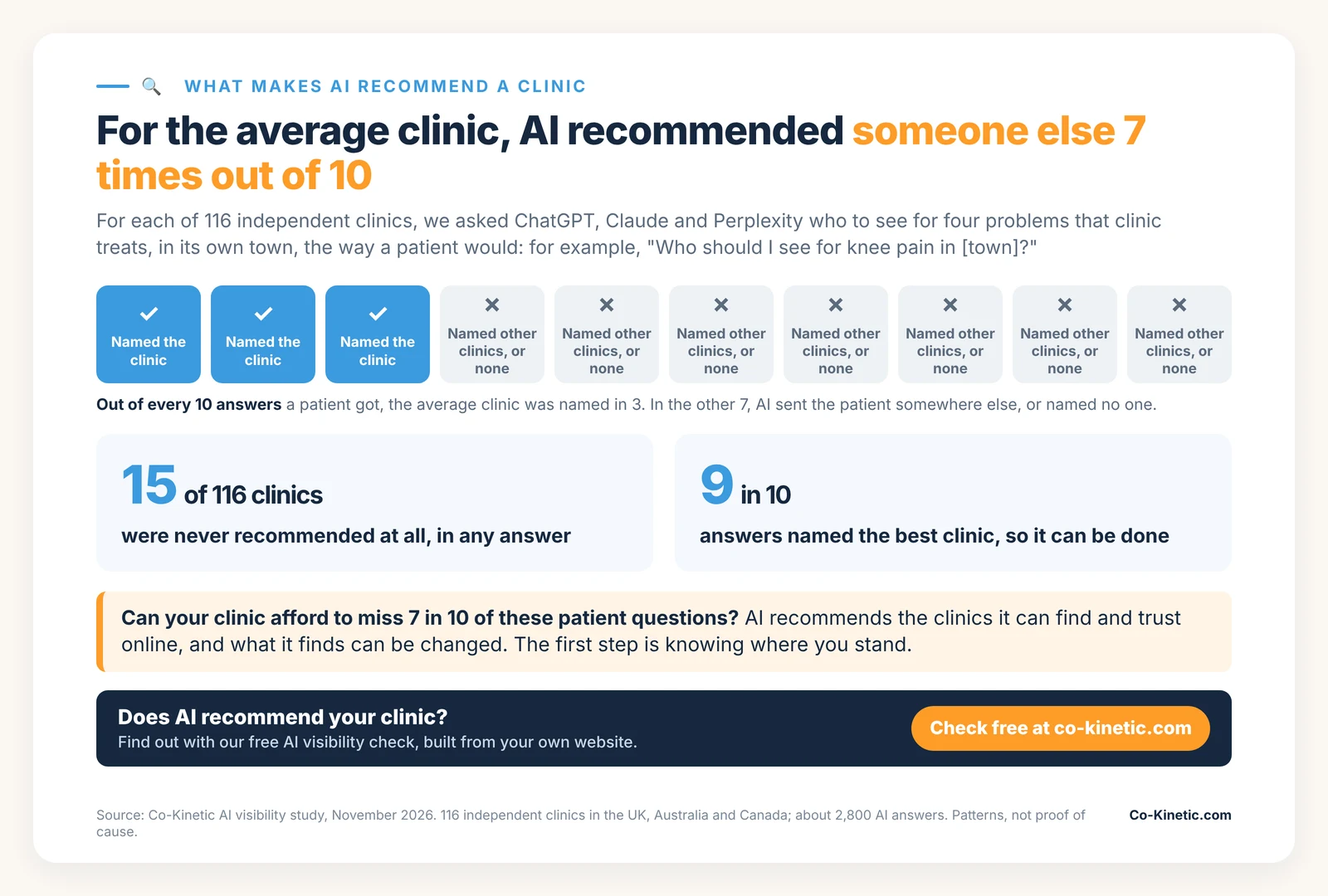
In the other answers, AI recommended other clinics instead, or gave general advice ("see a physiotherapist") without naming anyone. So there's a big gap between clinics. Here's what went with being on the right side of it.
Where does your clinic sit? Run your free AI visibility check and find out how often AI recommends you, and who it recommends instead. It takes about 20 seconds to start.
1. Rich clinical content was the biggest thing a clinic can change
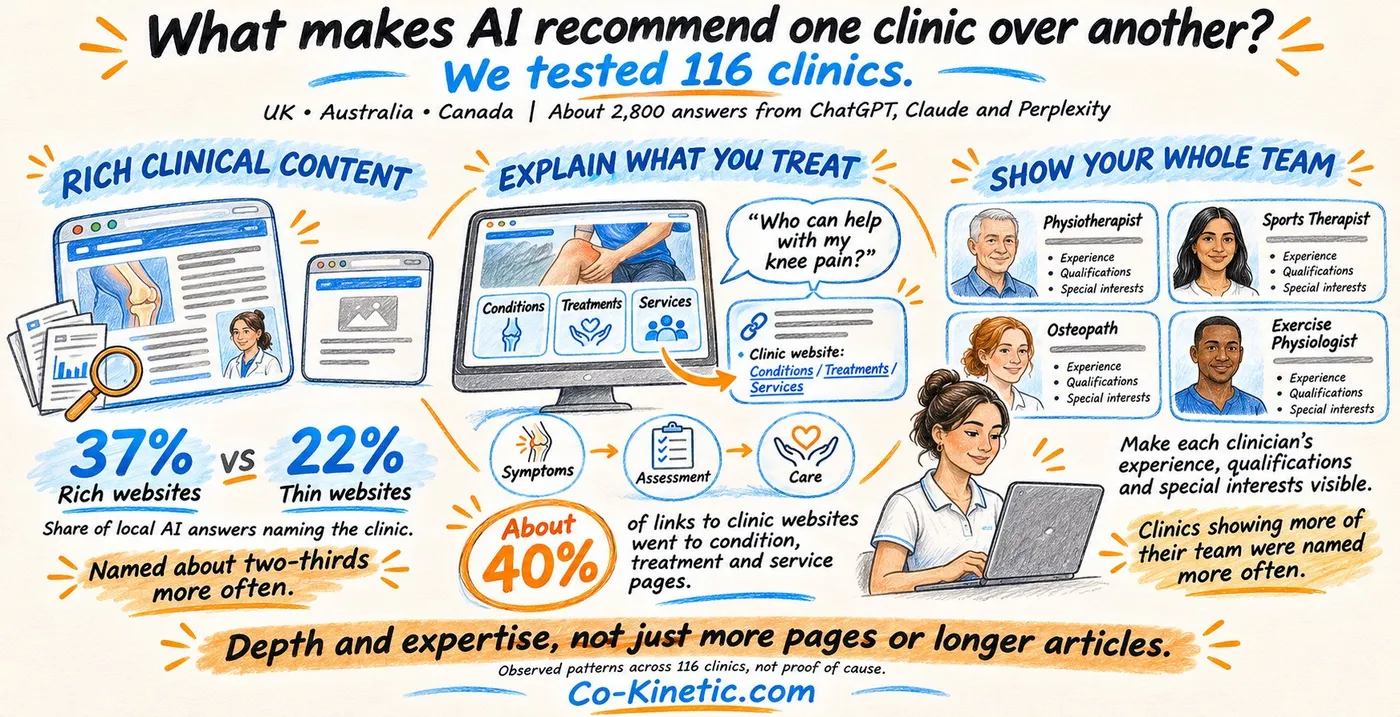
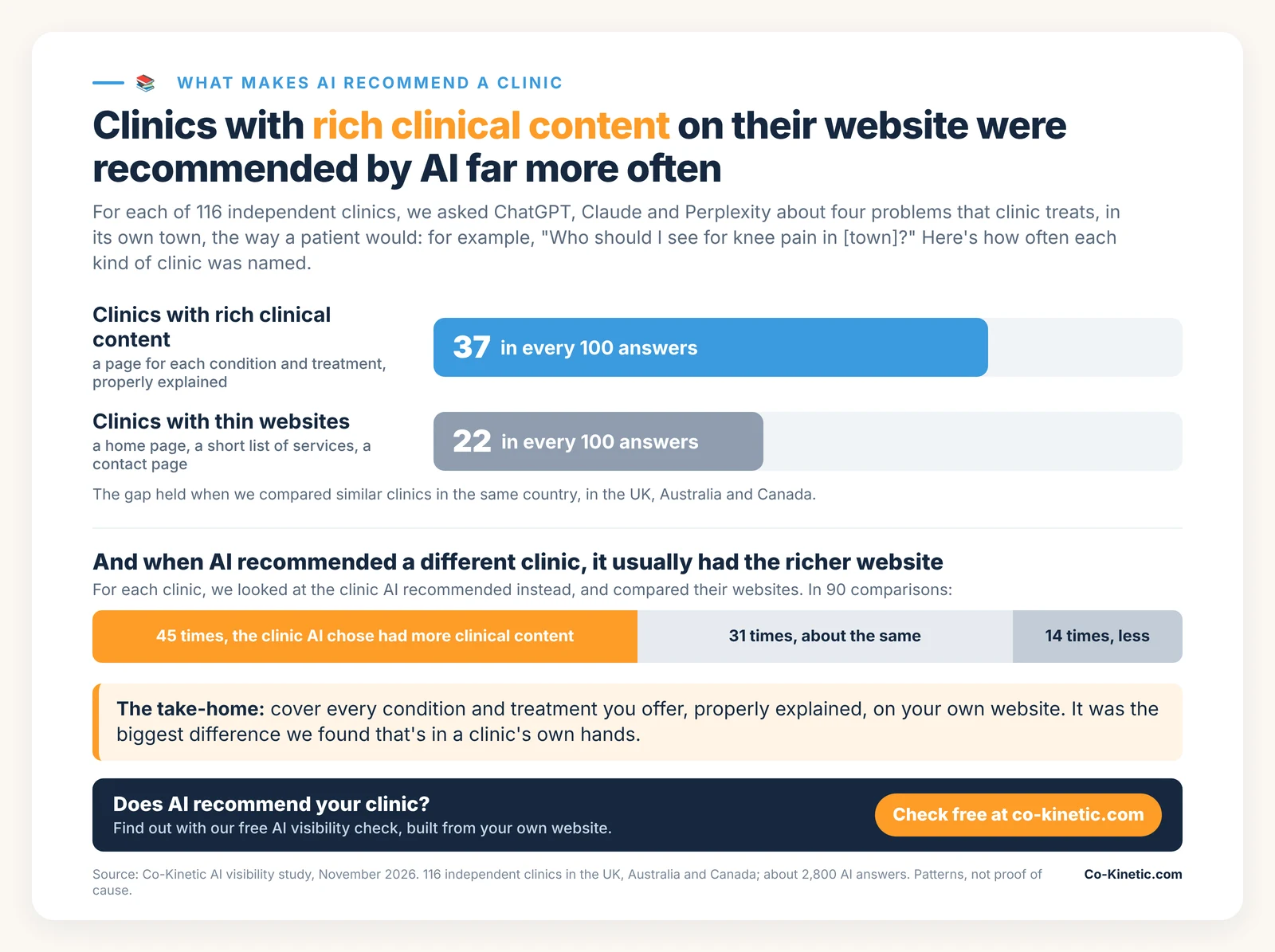
Clinics with rich clinical content on their website were named in 37% of answers. Clinics with thin websites were named in 22%.
That's about two-thirds more often. It held in the UK, Australia and Canada, and comparing like with like, the gap was still 13 points. It still held when we added Google's AI answers to the three tools (38% against 25%). Of everything a clinic can change, this showed the biggest and most reliable difference.
We also looked at the clinic AI recommended instead of each one. The other clinic had the richer website in 45 pairs, and the poorer one in only 14. And the bigger the gap in content, the more often AI chose the other clinic. Of everything we compared, content was the only difference that worked like that.
What rich clinical content looked like. The clinics with rich content typically had:
- a page for each condition they treat, and each treatment and service they offer;
- on each page, a proper explanation: what the problem is, its symptoms and causes, how the clinic assesses and treats it, what happens at the first appointment, how long recovery usually takes, and when to get help;
- the clinic's own approach and its clinicians' expertise coming through, not generic text.
A thin website, by comparison, had a home page, a list of services with a line or two each, and a contact page.
Quality, not quantity. We checked whether simply having more, or longer, was what made the difference. It wasn't:
- More pages didn't help by themselves. Once we allowed for how rich the content was, a much bigger website added nothing.
- Longer pages didn't help. Pages under 400 words did as well as pages over 1,000.
- One page on the exact problem didn't help by itself. Clinics with a dedicated page for the problem the patient asked about were named no more often than clinics without one: 30% against 30%.
What made the difference was the whole website properly covering what the clinic treats, in real depth. That's what gives AI enough to understand what a clinic does, and to trust it.
2. AI sends patients to the pages that say what you treat
When AI recommended a clinic and linked to its website, this is where the links went:
| Page | Share of links |
|---|---|
| Condition, treatment and service pages | about 40% |
| Home page | about 30% |
| Contact, booking, prices or FAQ | about 10% |
| About or team page | about 6% |
| Blog posts | about 3% |
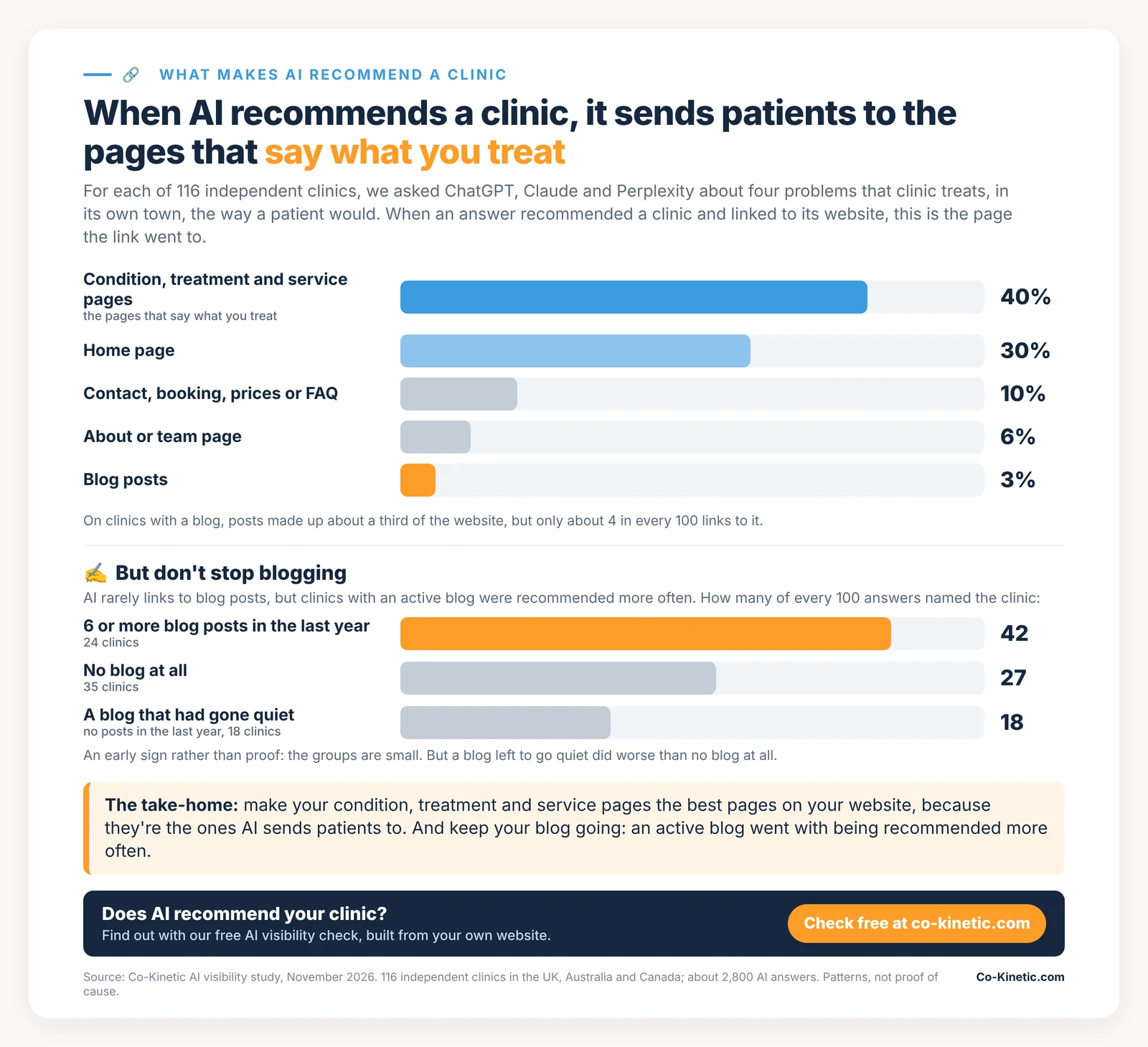
On clinics with a blog, posts made up about a third of the website but only about 4% of the links. The pages that explain what you treat are the ones AI sends patients to.
But don't stop blogging. Whether AI links to a page and whether it recommends the clinic at all are two different things. Clinics that published 6 or more blog posts in the last year were named in 42% of answers, against 27% for clinics with no blog, and just 18% for clinics whose blog had gone quiet. The groups are small, so treat this as an early sign rather than proof. But the message is clear: if you have a blog, keep it going, because a blog left to go quiet did worse than no blog at all.
3. Show your team
Clinics that showed 5 or more practitioners on their website were named in 41% of answers. Clinics that showed fewer were named in 26%.
You might think that's just because bigger clinics have bigger websites. We tested it, and it isn't. Comparing websites of the same size, the ones showing five or more practitioners were still named more often. The number of pages made no difference on its own. It still held with Google's AI answers added (42% against 28%).
And the clinic AI recommended instead usually showed more of its team: typically 6 clinicians, against 2 for the clinic it passed over.
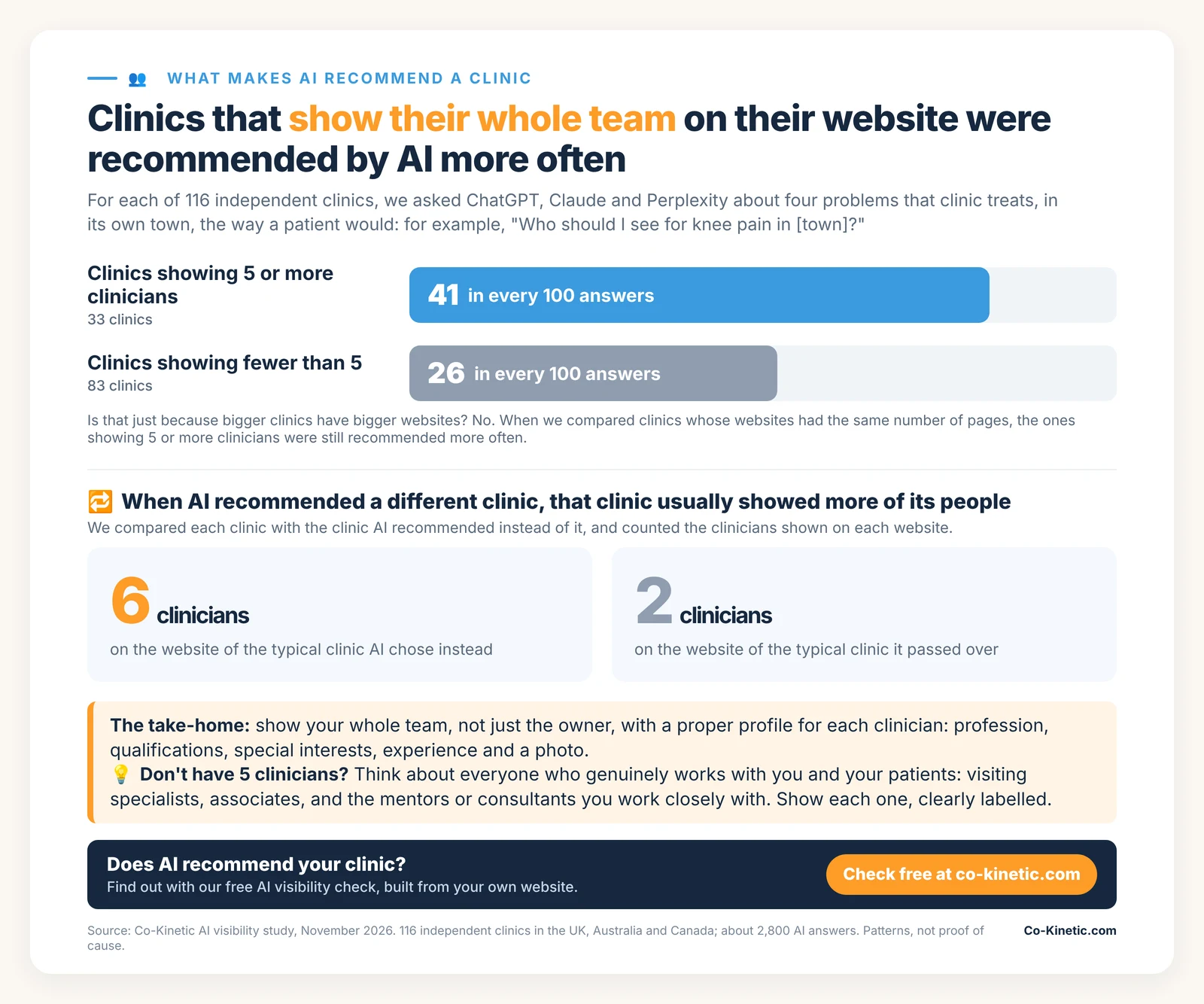
One caution: a big team can also mean a bigger, better-known clinic, so this is a link, not proof. But it's good practice anyway. Show your whole team, not just the owner, and give each person a detailed profile: their profession, qualifications, special interests, experience and a photo. It gives AI, and patients, more to go on.
What if you're a smaller clinic? Include everyone who genuinely works with you and your patients: visiting specialists, associates, and the mentors or consultants you work closely with, each clearly labelled for what they do.
Want to see how your own clinic does on all of this?
Run your free checkFree, for independent MSK clinics. It takes about 20 seconds to start.
4. What we couldn't find a difference for
Some of the things clinics worry about most showed no difference we could measure in this study. That's not the same as saying they never matter. It means that, for these clinics and these patient questions, the numbers didn't show a link.
| What | What we found |
|---|---|
| Number of Google reviews, in ChatGPT, Claude and Perplexity | Clinics were named in 28% to 32% of answers whatever their review count (0 to 19 reviews: 28%; 20 to 99: 32%; 100 to 299: 30%; 300 or more: 31%). The clinic AI picked instead had more reviews in 52 pairs and fewer in 49: no pattern at all. Google's own AI answers: see below |
| More pages, for the sake of it | No difference, once rich content and team size were counted |
| Longer pages | No difference |
| A Facebook page | No difference, once we compared like with like |
| An llms.txt file (a file some websites add for AI tools) | No difference: 31% with one, 30% without |
| Calling yourself a specialist clinic, without the content to back it up | No difference |
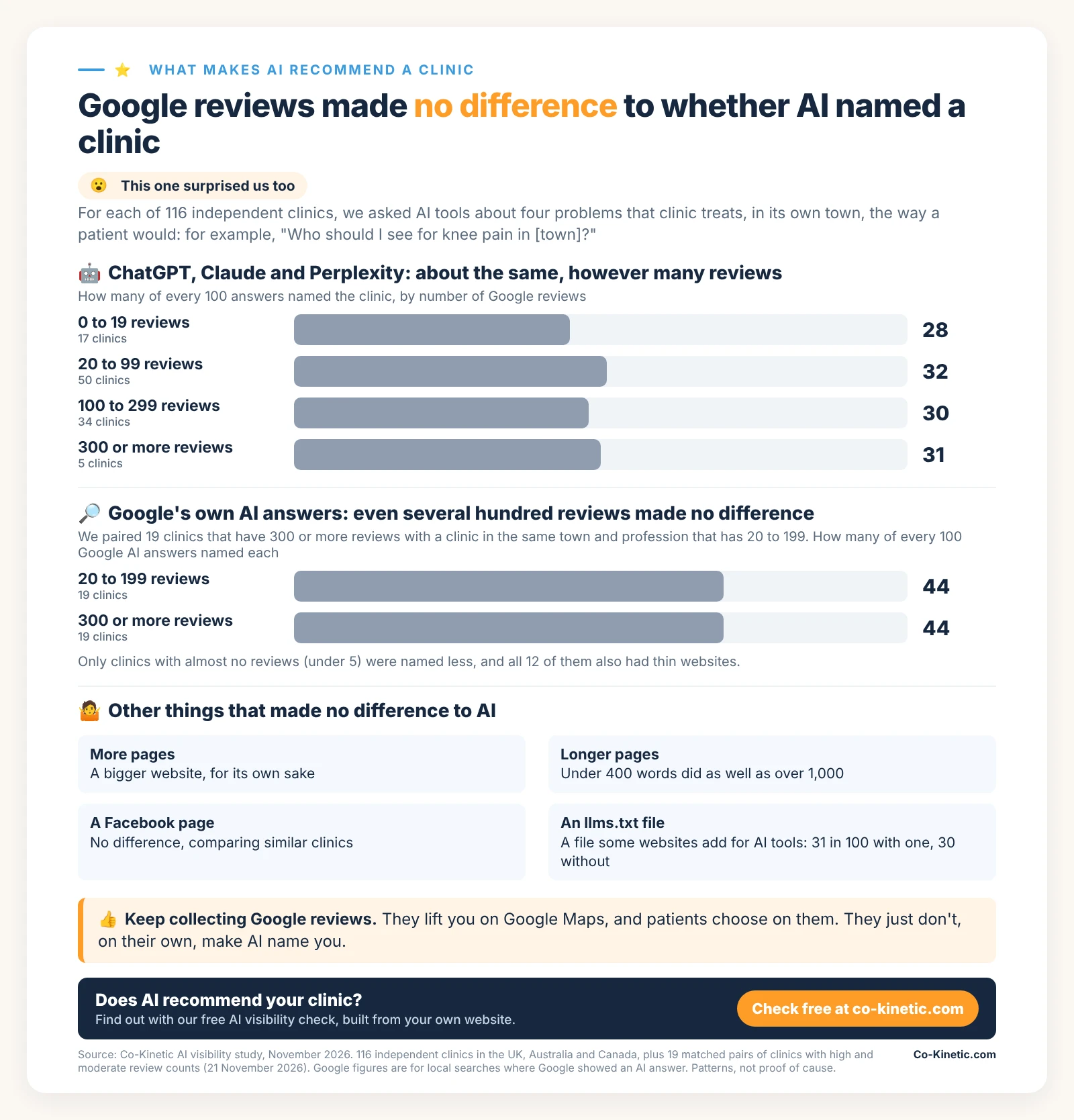
Google reviews: what we measured, and what we didn't. Our study looked at one thing: whether AI names a clinic when a patient asks who to see locally. It didn't measure all the other jobs reviews do.
- ChatGPT, Claude and Perplexity: the number of Google reviews made no difference to whether they named a clinic.
- Google's own AI answers: no link either, once a clinic had more than a handful. We tested this hard: we paired 19 clinics that have 300 or more reviews with a clinic in the same town and profession that has 20 to 199. Google's AI named both groups in 44% of its answers. The only clinics it named less often were the 12 with fewer than 5 reviews, and every one of those also had a thin website, so that may say more about their websites than their reviews.
- Google Maps: here reviews clearly help. Clinics with 20 to 99 reviews were in the Maps top 3 for their profession and town 65% of the time, and clinics with 100 to 299 73%, against 42% for clinics with fewer than 20. In our pairs, 13 of the 19 clinics with 300 or more reviews were in the top 3, against 7 of 20 nearby clinics with fewer. Patients searching "physio near me" see that list first.
- Patients: reviews matter enormously. A patient comparing a clinic with 350 reviews and one with 20 will usually choose the first.
So keep asking every happy patient for a Google review, however many you already have. Reviews lift you on Google Maps and help patients choose you. Just don't expect a bigger number, on its own, to make AI name you.
A word of honesty about what this is
These are patterns we found across 116 clinics, not proof that one thing causes another. The clinics were picked to cover different sizes, places and kinds of clinic, so they're not a random sample. And AI doesn't give the same answer every time: one clinic's result can move between two checks just by chance. The main gaps above are six to eight times bigger than that, so they're not down to luck, but no single check tells the whole story.
We're carrying on. Every new check adds to what we know, and we'll update these findings as the picture changes.
What this means for your clinic, in short
- Cover what you treat, in depth. A page for each condition, treatment and service, properly explained, with your clinicians' expertise coming through.
- Put those pages first. They're the ones AI sends patients to.
- Show your whole team, with a proper profile for each clinician.
- Don't chase page counts or word counts. Depth and quality made the difference, not volume.
- Keep asking every happy patient for a Google review, however many you already have. Patients choose on them, and more reviews go with a higher place on Google Maps.
We've built these findings into how the Clinical Content System plans and writes content for our clinics.
Coming in part 2, next week
There's a lot more in the data. Next week:
- ChatGPT and the other AI tools look in completely different places. One of them mostly ignores your website and reads something else instead. Which one, and what to do about it.
- Where you are matters more than you'd think. How the number of clinics around you changes your chances, and what to do if you're in a busy area.
- Blogs in more detail: what an active blog seems to do for a clinic, even though AI rarely links to the posts, and how often to post.
- Specialist problems, and being known for something: when a speciality helps, and when it makes no difference.
- The smaller things that seem to help: pages for the nearby towns you serve, other websites that mention you, clinic directories, and one free fix for your home page.
- Why your score can move between checks, and how to read it.
What next for your clinic?
Our free AI visibility check runs the same kind of test on your own clinic. It reads your website, picks four problems you treat, and follows each one as a real patient conversation on ChatGPT, Claude, Perplexity and Google's AI Overviews, in your own town, right through to "which clinic should I book?". Then it emails you the report.
It's free and takes seconds to start. It's built for independent MSK clinics: physiotherapists, osteopaths, chiropractors, sports therapists and similar.
Reference
- Co-Kinetic. AI visibility study, Phase 2: what makes a clinic findable by AI, findings v9. 116 independent physiotherapy, osteopathy and chiropractic clinics in the UK, Australia and Canada; about 2,800 answers from ChatGPT, Claude and Perplexity, and about 900 local Google searches. 19 November 2026.
?Frequently Asked Questions
What makes AI recommend one clinic over another?
In our study of 116 independent physio, osteopathy and chiropractic clinics, the biggest difference a clinic can make was rich clinical content across its website. Clinics with rich content were named in 37% of local AI answers, against 22% for clinics with thin websites. Clinics that showed five or more clinicians on their website were also named more often, 41% against 26%.
Do Google reviews help a clinic get recommended by AI?
Our study only measured whether AI named a clinic, not the other jobs reviews do. The number of Google reviews made no difference to ChatGPT, Claude or Perplexity, and in Google's own AI, clinics with 300 or more reviews were named no more often than nearby clinics with 20 to 199. Reviews do go with a higher place on Google Maps, and patients choose on them, so keep asking every happy patient for one.
Does a bigger website get recommended more by AI?
Not on its own. Once we allowed for how rich the content was, a much bigger website added nothing. Longer pages didn't help either. What made the difference was the whole website covering what the clinic treats, in real depth.
Which pages does AI link to when it recommends a clinic?
Mostly the pages that say what the clinic treats. Condition, treatment and service pages took about 40% of the links AI gave to clinic websites, and the home page about 30%. Blog posts took about 3%.
How can I see whether AI recommends my clinic?
Run Co-Kinetic's free AI visibility check. It reads your website, picks four problems your clinic treats, and follows each one as a real patient conversation on ChatGPT, Claude, Perplexity and Google's AI Overviews, in your own town, then emails you the report.