Why does my clinician's profile matter so much?
This is part of the Clinical Content System subscription. If your clinic isn't subscribed yet, you can see what the Clinical Content System includes.
Sound familiar?
"Do we really have to fill all this in?" "Can we skip the profiles and get straight to the content?" "Nobody reads staff bios anyway." "My physios think this is admin." All versions of the same question, and it is the most important question on the platform, so here is the full answer, including the evidence.
What's happening
The clinician profile is not a CV, and it is not a staff bio page. It is the raw material the whole platform runs on. One profile feeds all of this at once:
- Every article we write for you. The conditions, techniques and patient groups in the profile are what the writing draws on, so the content sounds like your clinician and nobody else's.
- The named author and reviewer credit on every clinical page you publish.
- The author and reviewer information published with every clinical page, so the named clinician behind a piece can be traced to their credentials and registration.
- Your public team page. Generated at team level: you choose which active clinicians to include, and their profiles are what it is built from.
- The clinician's own public profile page, including their clinical voice answers in their own words.
Fill it in once, and it works in all five places for as long as you are with us.
Why it works this way: what the evidence actually shows
When a patient asks ChatGPT, Perplexity or Google's AI "who should I see about my heel pain when I run?", the AI does not pick a clinic at random. It assembles an answer from sources it can identify, verify and quote. We have studied how those citation decisions get made, and four findings explain why the profile, and especially each clinician's individual voice, carries so much weight.
First: the broad terms are already lost, and specificity is where clinics win 🔍. Queries like "back pain" are saturated by hospital systems and major health institutions; no independent clinic wins there, and neither does a profile that says only "back pain". Where independent clinics genuinely get recommended is on specific, long-tail questions, and specific expertise is exactly what a well-filled profile expresses. "Shoulder pain" scores the same to an AI as every other clinic's "shoulder pain". "Rotator cuff tendinopathy, mostly overhead athletes in their 40s, progressive loading first" describes a clinician an AI can confidently name when someone asks a specific question.
Second: named, registered clinicians are what patients trust, and they cost you nothing 🧑⚕️. A big hospital outranks you on brand; it cannot match the specific, registered, named clinician who demonstrably treats exactly what the patient asked about. The profile is what puts their name, registration number and stated focus behind everything you publish, so a patient can see who wrote it and who checked it. That is why we never publish clinical content without a named, qualified author and reviewer drawn from these profiles.
Third: answering patients' real sub-questions is the strongest predictor of being cited ❓. The research is unambiguous: content that covers the specific questions patients actually ask (how long will this take to heal, when should I worry, what does treatment involve for someone like me) is what gets cited, and that coverage cannot be faked with a list of bare condition names. It comes from the depth questions in the profile: who do you most often treat for this, how do you approach it, what tells you it works. Those short answers are the seed of every specific, citable page we write for you.
Fourth, and this is why the individual voice matters so much: AI quotes people, not templates 💬. Quotable expert statements, a real clinician explaining something in their own distinctive words, measurably lift visibility in AI-generated answers. That is precisely what the six clinical voice questions capture: how this clinician actually talks about their work, published in their words on their public profile and woven into their content. It is the one part of the profile that cannot be delegated, imported or generated, because its entire value is that it could only have come from that person. Two clinicians can treat identical caseloads; their voices are what make them two different, individually recommendable experts rather than one interchangeable service.
And the profile now decides the order of your plan, not just the quality of the writing. Your plan is built from your practice priorities first, then your top five ranked services, then your top five ranked conditions, then your clinicians' specialisms. Within each of those, your clinicians settle what comes first. Starring a clinician in the Your Team panel lifts everything that person treats. Inside a profile, setting a single condition, technique or patient group to Boost lifts that item, and marking it Primary as well (one per list, locked for 90 days once set) says it is that clinician's key specialism. Anything else listed still counts, and the more of your team who share a specialism, the more strongly it counts. A topic three of your physios genuinely treat, declared properly, is a topic your plan will build early.
Put together: rich profiles produce content that could only have come from your clinic, written in your clinicians' voices, with their names attached and real depth in every answer, and depth on the questions patients actually ask is what AI search rewards ✨. Empty profiles produce content that could have come from anywhere, and generic content is precisely what AI search ignores.
That is also why the points sit where they do. The scoring was recalibrated in August 2026 to reward the distinctive parts most: the short depth questions on conditions and techniques, the patient groups you actually treat, your clinical voice, and what your clinicians do beyond the clinic. (The rescore was designed to preserve author and reviewer status, and there is a note in the app about it.)
Keep the profiles in Co-Kinetic up to date, and edit them there first. Your profiles in Co-Kinetic are the master copy. Your content plan, your articles and your author and reviewer details all read from them, not from your website. If a clinician's details change, or you edit a profile on your website, update it in Co-Kinetic too, otherwise your plan and your content won't know. The simplest habit: edit in Co-Kinetic, then copy the updated text onto your website.
What to do now
- Open the Clinician Profile page at https://content.co-kinetic.com/my-clinic/clinic-profile and look at each clinician's score. The friendly targets: 60% makes a clinician an author, 50% makes them a reviewer. Nobody needs 100% 🙂.
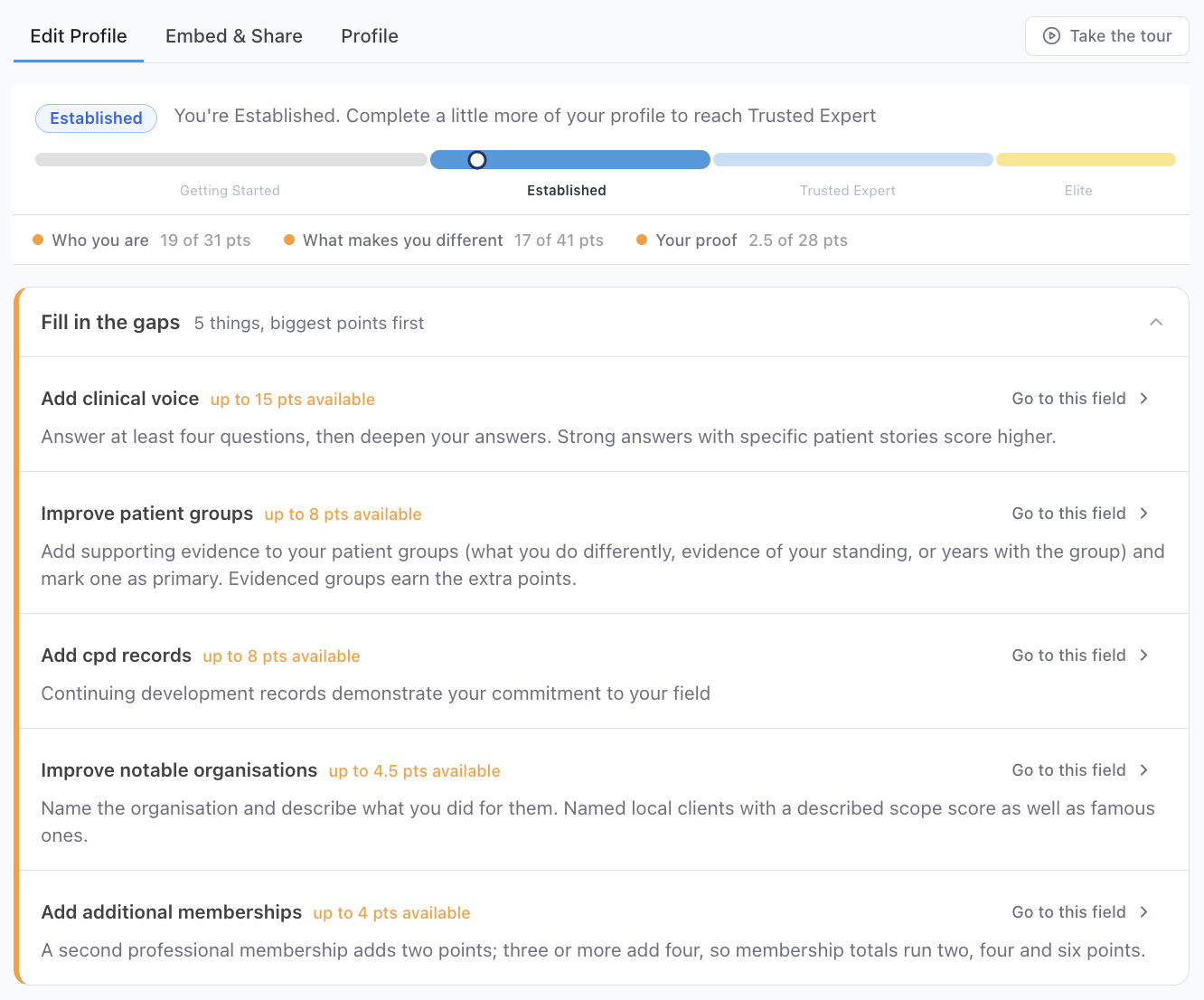
- Inside a profile, open the "Fill in the gaps" panel just under the score (it says something like "6 things, biggest points first"). It lists the highest-value unfinished items in order, so you always know the quickest route up. Every section also shows a small "x of y pts earned" chip.
- Give the clinical voice questions the best half hour. They are worth up to 15 points, they drive most of the AI-quality layer, and they are the part only the clinician themselves can do. The clinical voice preparation guide in the editor's Downloads panel (under Set-up and tools) is a five-minute read first, with do and don't examples included.
- For the full story of how AI reads a profile, download Making your clinician profiles unmistakably yours (a short PDF explainer; that link downloads it straight to your computer; it also lives in the Downloads panel). It is the five-minute start-here read, and the single best thing to hand a sceptical clinician.
- Short on time? The same Downloads panel has interview packs and a worksheet that do most of the collecting for you, and there are import routes for CVs, LinkedIn and existing bio pages. See "Is there a faster way to fill in clinician profiles?" for the whole toolkit, remembering that the depth and voice answers are the one part not to delegate.
The question behind the question
"Is this really the best use of my clinical time?" Yes, and it is the only heavy lift the platform will ever ask of your clinicians. When AI recommends a clinic, it cites the named clinician and their stated focus, which makes the profile the single most valuable marketing asset your clinic has 🏆. One properly filled-in profile feeds months of content. Everything after it is push-button.
The next question is usually...
- Is there a faster way to fill in clinician profiles?
- How are profile scores worked out, and how do I raise mine?
- How do we plan clinician profiles across a large team?
- Why do I need a reviewer at all?
Still stuck? This usually means...
- A clinician remains unconvinced. Give them the explainer PDF. It makes the case in five minutes, in their language.
- Everyone is convinced but nobody has time. The interview route was built for exactly this: 30 recorded minutes with a colleague, and we do the writing. "Is there a faster way to fill in clinician profiles?" has the whole toolkit.
- The profiles are done and you are not sure what changed. Watch the plan: deeper profiles feed the scoring at the next regeneration, and completed profiles unlock authoring and reviewing. "What happens once my content plan unlocks?" picks up the story.