What does my Site Health score mean?
This is part of the Clinical Content System subscription. If your clinic isn't subscribed yet, you can see what the Clinical Content System includes.
Sound familiar?
"What is the Site Health percentage actually measuring?" "What are the four categories under my score?" "Why is my site health low when the website looks fine to me?" "Is this the same as my AI Visibility score?" Site Health is the strength of your website itself; AI Visibility is whether AI tools cite you. This article explains the first one.
What's happening
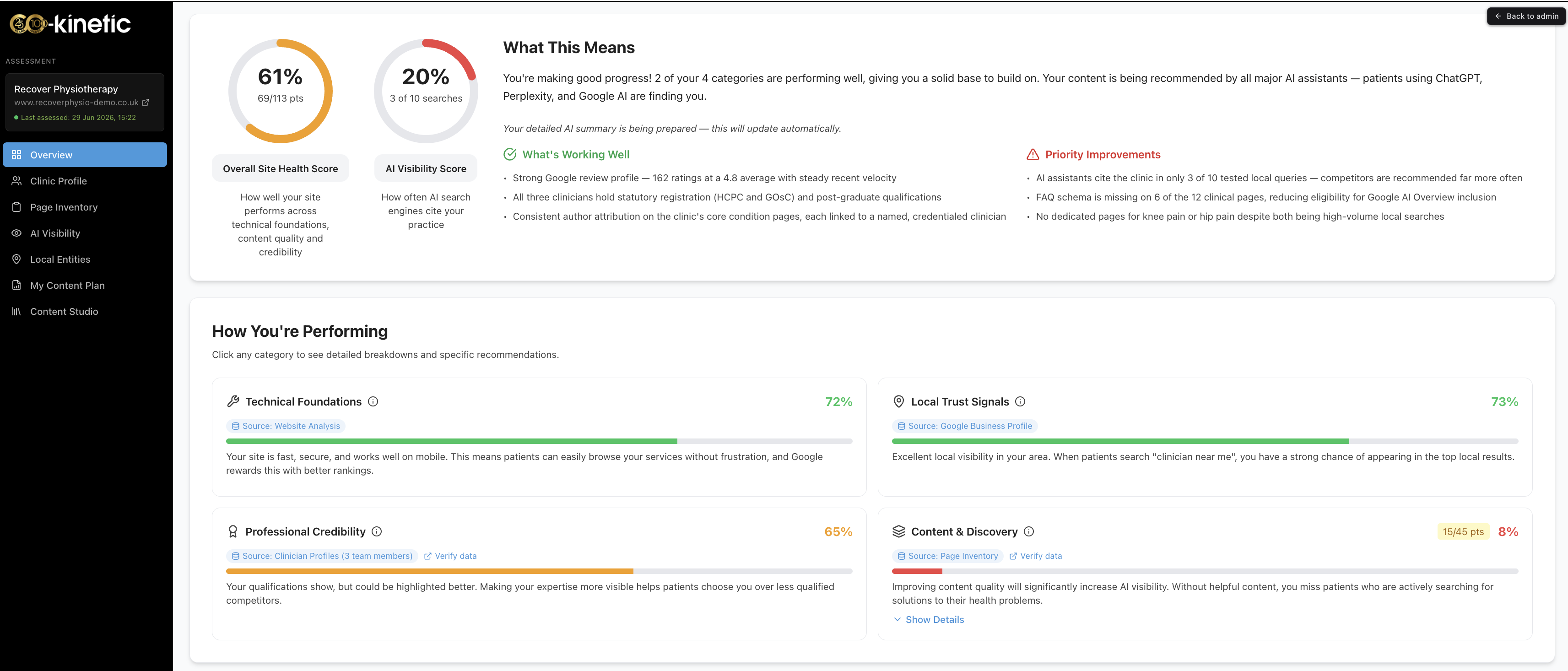
Your Site Health score is a percentage summarising how strong your website is for AI search, shown on the Overview page at https://content.co-kinetic.com/my-clinic/overview. It comes from your AI Visibility Assessment, which discovers your website's content pages and scores every eligible page individually: each against the criteria relevant to its page type from a checklist grounded in published research on how AI search engines choose their sources. A 100-page site gets 100 individual page evaluations, not a homepage skim 🔍. (Legal and boilerplate pages are sensibly left out, and very large sites are analysed up to a crawl limit.)
The score is broken into four categories, each shown as its own percentage:
- Technical foundations. The machine-readable groundwork: whether your site carries correct, complete structured data (schema, the coded labels that describe who your clinic is, who your practitioners are and what you treat), and whether your pages are structured so machines can read them confidently.
- Professional credibility. Whether your expertise is visible and verifiable: identifiable authors on your content, credentials and registrations on display, and complete, machine-readable practitioner profiles. Patients trust what they can trace to a real, named clinician.
- Local trust signals. The signals that tell AI you are a real, trusted local business: your Google Business Profile reviews (volume, rating, how recently they arrive) and how your clinic sits within its local healthcare landscape.
- Content & discovery. The strength of the content itself: depth, answer-first structure, evidence citations, freshness, internal linking, and how your pages actually place in search for relevant local healthcare queries.
Your overall Site Health score brings these four areas together, but not as a simple average. The categories are weighted by how much they matter to AI visibility: Content & discovery carries the most influence (roughly two-fifths of the total), then local trust signals (about a quarter), professional credibility (about a fifth), and technical foundations (about a seventh). That's deliberate: the evidence says content depth and discoverability move the needle most, so the score reflects where your effort pays off most. And the score isn't a separate opinion sitting next to your page inventory. Your actual pages feed it directly: how many content pages you have and of what types, whether your team page exists, named authors, structured data coverage, content depth and freshness, and where your pages rank.
One nuance worth knowing: your AI visibility results are counted inside Content & discovery (as part of how discoverable you are), not as a fifth category, which is why improving your content tends to lift both scores at once 📈.
Why it works this way
AI search engines pick sources that demonstrate depth, expertise and trustworthiness across the whole site, not just a pretty homepage. That is why a site can look lovely to a human and still score low: design is not what AI reads. The four categories mirror what AI engines actually weigh, so a low category is not a criticism, it is a map of where your biggest wins are 🗺️.
One date to know: on 21 September 2026 we rebuilt how pages are scored, on measured evidence about what actually gets pages cited. Checks that counted the same thing twice were merged, checks with no evidence behind them were dropped, and the strongest measured driver was added: how well a page answers the related questions patients actually ask. Every clinic's page scores, and so this score, moved on that date for reasons that had nothing to do with their website. If you're comparing a score from before 21 September with one after it, that is why they differ.
What to do now
- Open https://content.co-kinetic.com/my-clinic/overview and note your lowest category.
- Technical foundations low? Open the website optimisation brief and get the plugin and site-wide recommendations actioned (see "Where is my website optimisation brief?").
- Professional credibility low? Complete your clinician profiles (see "Why does my clinician's profile matter so much?").
- Content & discovery low? Work your plan at https://content.co-kinetic.com/my-clinic/plan, and see the Page Inventory at https://content.co-kinetic.com/my-clinic/page-inventory for exactly which pages are weak.
- Local trust signals low? Keep reviews flowing on your Google Business Profile: recent, steady reviews beat a burst from three years ago.
The question behind the question
"Is a low score bad news?" No. A low score means there is a lot of opportunity for improvement. Treat each score as a snapshot of where your site stands at that measurement, and the lowest category as the place your next effort pays off most. Practices do not buy the platform because their score is high 🙂.
The next question is usually...
- What does my AI Visibility score actually mean?
- What is the Page Inventory?
- What is the Overview page showing me?
- What is my article score, and how is it measured?
Still stuck? This usually means...
- You want to know exactly which pages are dragging a category down. Open the Page Inventory at https://content.co-kinetic.com/my-clinic/page-inventory: every page's individual score, its band and how many things it has to fix are listed there.
- You made changes and the score has not moved. Scores move when the site is re-measured, not instantly. If a re-measure has run and you expected movement, tell us in the chat and we will check the detail.
- You show registration numbers on your website but were told they're missing. The check looks for registration numbers displayed on your website as well as in your clinicians' profiles. It notes that a number is displayed; it doesn't check it against the register. If yours are displayed and still show as missing after your next assessment, tell us in the chat.
- You disagree with a finding. The assessment can be drilled into finding by finding, so ask us in the chat about the specific item: nothing is a black box.