What are niches and primary niches, and how do they shape my plan?
This is part of the Clinical Content System subscription. If your clinic isn't subscribed yet, you can see what the Clinical Content System includes.
Sound familiar?
"What counts as a niche?" "Where do I declare one?" "Why does the plan keep suggesting vestibular content?" (Almost certainly because someone on your team declared it.) "Does it matter how specific we are?" It matters enormously, and it is the single most powerful connection between your team and your content plan.
What's happening
A niche is a clinician's declared expertise: the specific things they actually treat, recorded in their profile. In the profile editor at https://content.co-kinetic.com/my-clinic/clinic-profile, niches live in three sections:
- Conditions you most often treat: the three to six conditions they see most, specifically named ("rotator cuff tendinopathy", not "shoulder pain").
- Treatments and techniques: the techniques that set them apart (dry needling, McKenzie Method), not the baseline repertoire.
- Patient groups you specialise in treating: the populations they have focused experience with (postnatal mothers, adolescent dancers, runners). This section used to be called "specialist niches".
When a clinician declares a niche, it activates the matching topic area for your clinic. That topic area is a whole structure: a comprehensive hub page plus a set of supporting pages, each answering one specific patient question. Declared expertise we have already curated activates with all that quality pre-built; declare something rarer and the platform builds a complete topic area for your practice on the fly, same architecture either way. Your assessment can also propose a niche your site clearly shows but nobody declared, always subject to your confirmation: nothing activates behind your back 🔒.
Why it works this way
Your priorities and top five services and conditions always get a place in your plan. Your clinicians' niches add their own expertise on top, and matter for every piece, because when the content is published, that clinician's name and profile will stand behind it, and their real experience is what gives the writing its depth. A clinic publishing on topics nobody there treats has nothing specific to say, and that kind of generic content is exactly what AI search passes over.
And strength matters, not just presence. A topic that sits at the centre of a profile counts for far more than a bare entry in a list, and there are three separate controls that say so. They are easy to mix up, so here is exactly what each one does:
- The star in the Your Team panel sits on the clinician, not on a topic. It is the strongest clinician signal there is, and it lifts everything that person treats.
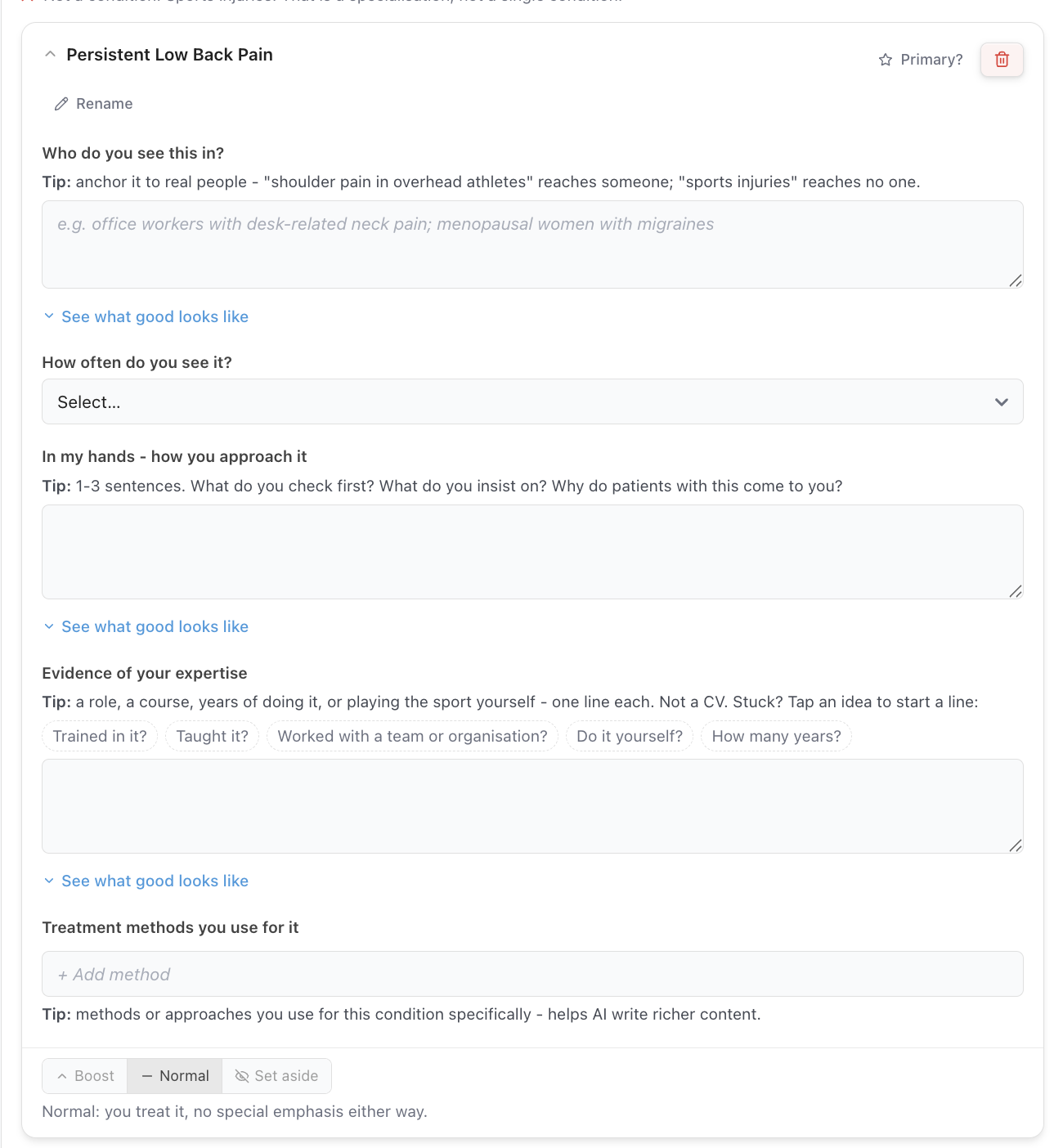
- The emphasis control on each item (Boost, Normal, Set aside) sits on one condition, technique or patient group. Boost lifts that item. Normal leaves it as a listed item. Set aside means it does not count at all.
- The Primary marker on an item says this is the clinician's key specialism in that list. Each list (niches, conditions, techniques) can have one Primary. It counts as much as starring the clinician, it starts full research on that topic, and once set it is locked for 90 days, so choose it carefully.
So if there is one topic a clinician should be known for, the combination that says it loudest is: named specifically, depth detail filled in, set to Boost, and marked Primary.
Specificity is the multiplier on all of it. "Shoulder pain" scores the same to an AI as every other clinic's "shoulder pain". "Rotator cuff tendinopathy, mostly overhead athletes in their 40s" is a clinician an AI can confidently recommend for a specific question.
What to do now
- Open https://content.co-kinetic.com/my-clinic/clinic-profile and open each clinician's profile.
- Check the three sections above cover what each clinician genuinely treats, named specifically. Anything missing is a topic area your plan currently cannot build.
- Fill in the short depth detail on each entry: a sentence is enough, and it is what turns a mention into evidenced expertise (it earns bonus points too).
- Use the emphasis control deliberately rather than leaving everything on Normal: Boost the few things each clinician should genuinely be known for, and set aside anything they list but would rather not attract.
- For a topic your practice wants pushed up the plan, make sure the clinician who genuinely carries it has it properly evidenced, then see "How do I push a topic up my content plan?" for the full playbook.
The question behind the question
"Will this over-influence my content? Am I going to get pigeonholed into that topic?" No, and the structure of the plan is what protects you. Your plan is led by your practice priorities, then your top five ranked services, then your top five ranked conditions, and every one of those is guaranteed a place. What your clinicians carry decides the order within each part of the plan rather than replacing it, and no topic can take more than three places, so a boosted or primary niche brings a topic forward without pushing aside the things you ranked. Declare what is true, declare it specifically, and the plan builds around your actual team.
The next question is usually...
- How do I push a topic up my content plan?
- What do practice priorities actually do?
- Why does my clinician's profile matter so much?
- How are profile scores worked out, and how do I raise mine?
Still stuck? This usually means...
- A declared niche has not produced any plan content. Check it is specifically named with its depth questions answered (a bare entry sends a weak signal), then wait for the next plan refresh ("When does my content plan change or refresh?").
- The plan keeps suggesting a topic nobody wants. Someone on the team probably declared it: check each profile's three niche sections, and mark unwanted suggestions "Not relevant" meanwhile.
- You cannot decide what counts as a niche versus a routine part of the job. Ask "would a colleague send this patient to this clinician specifically?" If yes, it is a niche. Declare it specifically and answer the depth questions.