How is my content plan organised, and how does it decide what goes where?
This is part of the Clinical Content System subscription. If your clinic isn't subscribed yet, you can see what the Clinical Content System includes.
Sound familiar?
"Who actually decides what's on my plan?" "Why these 15 things and not others?" "Is this just an AI brainstorming blog ideas?" "How does it know what my clinic needs?" Fair questions, and the answer is the most interesting thing on the platform, so here is the whole story.
What's happening
Your plan is built from what you have told us, in a definite order. It is not a list of ideas, and it is not the platform's opinion of your clinic. It is your own stated priorities, worked out into 15 pieces of content and put in order.
On your plan page the items are numbered 1 to 15 and grouped under five headings, in this order:
- Your Practice Priorities. Up to three, all counting equally. These are the things you said you want the practice known for.
- Your top services. The first five on your ranked services list, in the order you ranked them.
- Your top conditions. The first five on your ranked conditions list, in order.
- Your clinicians' specialisms. Anything ranked sixth or lower, and expertise your clinicians hold that you have not ranked at all.
- Building out your topics. The remaining work that rounds out your topic areas.
Every priority, and every top-five service and condition, gets a place before anything else does. Usually that place is the topic's main page. If something stops a topic getting a place, for example we published its page for you recently, or you marked it "Not relevant", the plan records the reason. No single topic can take more than three places, so one subject can never take over your plan.
Your clinicians decide the order within each heading. A starred clinician counts most and lifts everything that person treats. Next come the items a clinician has marked as one of their key specialisms in their profile, then anything else they list. The more of your clinicians who share a specialism, the stronger it counts, because a topic three of your team treat is a topic your clinic can genuinely own.
Within a topic, the main page comes before its supporting articles. The order of the supporting articles is shaped by what patients search for, the questions they actually ask, and where AI tools recommend nearby clinics for that topic instead of you.
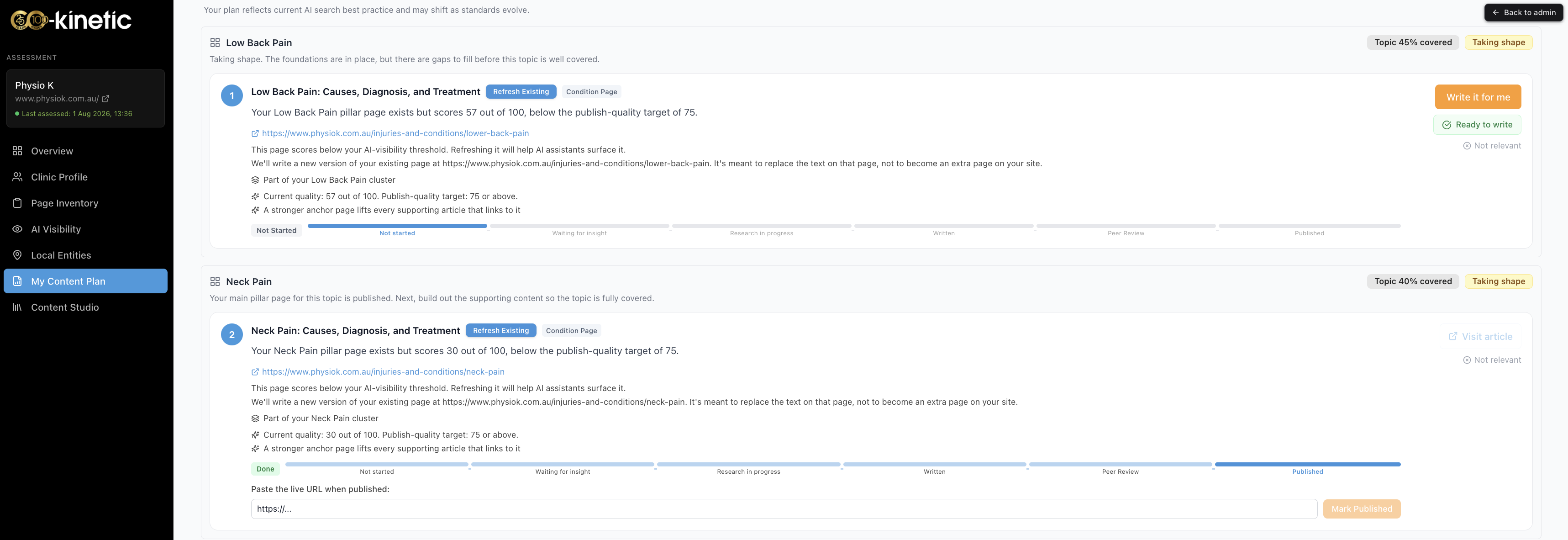
Your own existing pages can be your biggest quick wins. A page already on page one or two of Google for something you care about, a page that is slipping down Google, or a page on a topic where AI tools recommend a nearby competitor instead of you, gets a strong lift. Rewriting it replaces the text at the same address; it never adds a page. Pages that are already working are left alone: a page in Google's top three, or a page AI tools already cite for you, is never offered for a full rewrite.
Occasionally, an opportunity. At most two items per plan sit outside your lists, badged "Opportunity". They only appear when AI tools recommend nearby clinics for a topic, they don't recommend you, and one of your clinicians already treats it. You can reject them like anything else.
Pieces we have written for you leave your plan once published. They come back for a refresh no sooner than 12 weeks later, or sooner if the clinical evidence behind them changes, such as a new guideline. Refreshes of our pieces come after new work, weakest page first compared with the rest of your own site.
Why it works this way
Because the order is an argument, and it has to be one you would make yourself.
A plan that led with whatever looked popular would send you off writing about things you do not treat. A plan that led with our view of your gaps would be us telling you what your clinic is. Starting from your priorities and your ranked lists means the plan can only ever be a sharper version of your own strategy, with the measurement doing the part you cannot do by hand, which piece first, what patients actually ask, and where you are being left out of AI answers that name your competitors.
Your clinicians' profiles carry real weight for a reason worth understanding. What gets a clinic named in AI answers is content that answers the specific questions patients actually ask, in real depth. That depth comes from your clinicians: what they treat, who they see and how they approach it. A deep profile gives the writing specific, true detail that a thin profile can't. The platform also links every article to its named author and reviewer, so a patient reading it can see exactly who stands behind it.
Two more things worth knowing:
- Every item tells you why it is there. Each card's "Why this is in your plan" explanation names the evidence: the competitor and the AI tool that recommended them, the Google position, your ranking, your clinicians by name. A card links a topic to a Practice Priority only when it genuinely belongs to it ("It relates to your Practice Priority, …"), names the clinician who treats it ("[Name] treats this…"), and shows at most one search figure, worded "Around [N] people in [Country] search for "[keyword]" each month." Nothing is "the algorithm said so."
- The plan reflects your settings as of the last time it was built. Change a Practice Priority or your top five ranking and the plan rebuilds itself about an hour later (at most once a day). Other changes arrive the next time you press Refresh Content Plan.
What to do now
- Open your plan at https://content.co-kinetic.com/my-clinic/plan and read the explanation on the top three items.
- Check that your priorities and your ranked services and conditions on the clinic profile page still say what you want them to say. They are the first thing the plan reads.
- Check your own pages' scores in the page inventory at https://content.co-kinetic.com/my-clinic/page-inventory. That is the evidence behind rewrite suggestions.
- Want a particular topic higher? The levers are in "How do I push a topic up my content plan?"
The question behind the question
"Can I actually trust the order?" Yes, and you do not have to take that on faith. Every item names the reason it is there, in your own terms: your priority, your ranking, your clinicians, the competitor beating you. If an item's reason does not stand up, tell us, because the reason is meant to be something you could argue with.
The next question is usually...
- How do I push a topic up my content plan?
- I ranked my services and conditions by preference, but my content plan doesn't follow that order. Why?
- What do practice priorities actually do?
- Why does my clinician's profile matter so much?
Still stuck? This usually means...
- An item's reason does not convince you. Tell us in the chat with the item's title. The full workings are kept for every plan, and we can show you exactly why it placed where it did.
- A topic you care about is missing entirely. That is a levers question, not an ordering one: "How do I push a topic up my content plan?" walks through them.
- The plan does not reflect a change you made. It will once it is refreshed. See "When does my content plan change or refresh?"