How are profile scores worked out, and how do I raise mine?
This is part of the Clinical Content System subscription. If your clinic isn't subscribed yet, you can see what the Clinical Content System includes.
Sound familiar?
"I'm stuck at 43%." "What is actually being scored?" "How do I get to 60?" "My score changed and I didn't touch anything." "My screen shows a number bigger than 100." All answered below, including the full section-by-section points map.
What's happening
Every profile has a completeness score out of 100, built from points across the sections of the editor. Two numbers matter, both on that core score:
- 60 or more: the clinician can be the named author of generated content.
- 50 or more: they can be named as a clinical reviewer.
Your content plan unlocks when one active clinician reaches 60%+ and a different active clinician reaches 50%+. Once earned, the unlock is remembered: score changes never take it away (the plan simply needs at least two active clinicians to stay available).
You may also see up to 35 extra display points on top: an AI-quality layer that rewards the depth and specificity of the clinical voice answers and CPD detail, shown as a combined display of up to 135. The author and reviewer gates use the core score out of 100 only, so nobody needs the quality points to unlock anything.
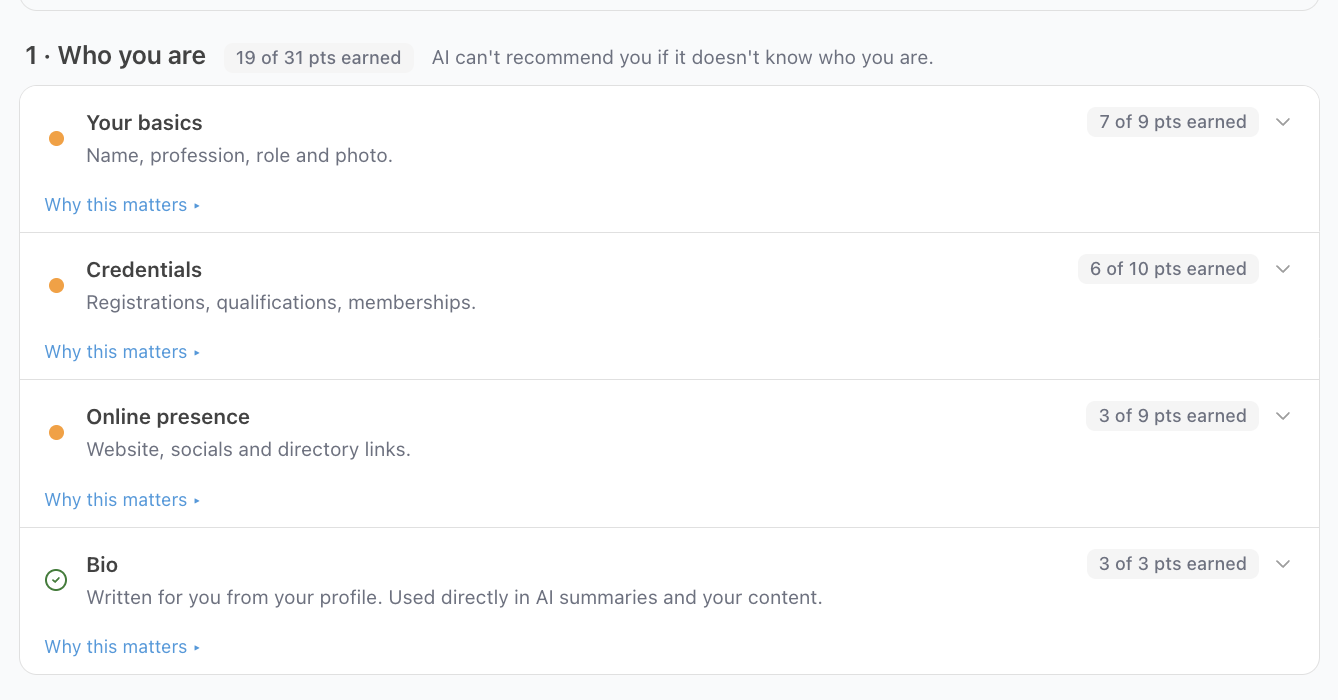
You can always see where points are hiding: every chapter and section shows a small "x of y pts earned" chip, so you can see exactly what you have earned and what is still available in each section.
One thing the plan does with these numbers: profile completion prompts on your content plan appear only for clinicians below 60%. Once a clinician passes the authoring threshold, the plan stops asking for more and simply uses what is in the profile. A clinician we hold no completeness figure for gets the prompt until we do. So a profile at 62% is not unfinished in the plan's eyes, and nobody is chased toward 100.
Why it works this way
The points sit where AI visibility is won. AI search rewards detail, individuality, experience and depth, so the editor's chapters are weighted accordingly: Who you are (31 points), What makes you different (41 points), Your proof (28 points), plus Beyond the clinic (3 points). Here is where the points live inside them:
- Basics: name, profession, position, years of experience, and the professional photo (2 points, and one of the strongest human trust signals; JPEG or PNG, ideally 400 x 400 pixels or larger).
- Credentials: your regulatory registration (body, number, verification URL, e.g. HCPC for UK physiotherapists); qualifications, each with a year, institution and a type dropdown (degree and diploma types earn 2 points each, a certificate 1, short course or "not sure" 0, and a qualification with no type chosen earns nothing); professional memberships (1 earns 2 points, 2 earn 4, 3 or more earn 6).
- Online presence: LinkedIn (3), a personal blog or thought-leadership URL (3), a YouTube channel (3). The clinic website field earns no points (every clinic has one) but fill it anyway: your public profile links through it.
- Conditions you most often treat: your three to six most-seen conditions, specifically named ("rotator cuff tendinopathy", not "shoulder pain"), each with a short depth field: who you typically see it in. Up to 8 points for the section, and each filled depth field adds a bonus point (up to 2).
- Treatments and techniques: the techniques that set you apart, each with a short depth field: how you use it. Up to 6.
- Patient groups you specialise in treating: the populations you have focused experience with (postnatal mothers, adolescent dancers, runners), with supporting-detail fields per group. Up to 12: any supporting detail marks a group as evidenced, and the depth points start once two or more groups are evidenced.
- Notable organisations: community connections such as team physio for a rugby club or a referral partnership with a school. Up to 7, assessed on specificity.
- CPD records: your most significant recent CPD. Up to 8 for count and recency, plus visible CPD quality points in the AI-quality layer.
- Achievements: awards, media features, certifications and speaking engagements. Up to 6.
- Publications: journal articles, books, conference papers, plus academic profile URLs (ORCID, Google Scholar, ResearchGate: any one earns the point). Up to 7. Most clinicians have none, and that is fine.
- Beyond the clinic: a short personal note in your own words. 3 points, not quality-scored, and one of the most-read parts of any profile: patients choose people.
- Clinical voice: six conversational questions about how you actually talk about your work. Up to 15 (1 point per answered question up to 4, plus AI-assessed depth up to 11). These answers appear on your public profile as written and drive most of the quality layer.
- The bio: generated automatically from everything above, so nobody writes it by hand. It earns 3 points; the fields above are where most of the score is.
About the August 2026 recalibration: points moved toward what makes a clinician distinctive (the depth questions, patient groups, Beyond the clinic, qualification types), and there is a note about it in the app. The recalibration was designed to preserve existing eligibility: author and reviewer status were kept even where a displayed score moved down, and the editor shows a note explaining the change.
What to do now
Go straight to the "Fill in the gaps" panel at the top of the profile editor. It does the thinking for you: it lists the unfinished items with the biggest points first, tells you what each one is worth, and the "Go to this field" link takes you straight there. Work it top to bottom and you are always earning the most points available for the least effort 🍒.
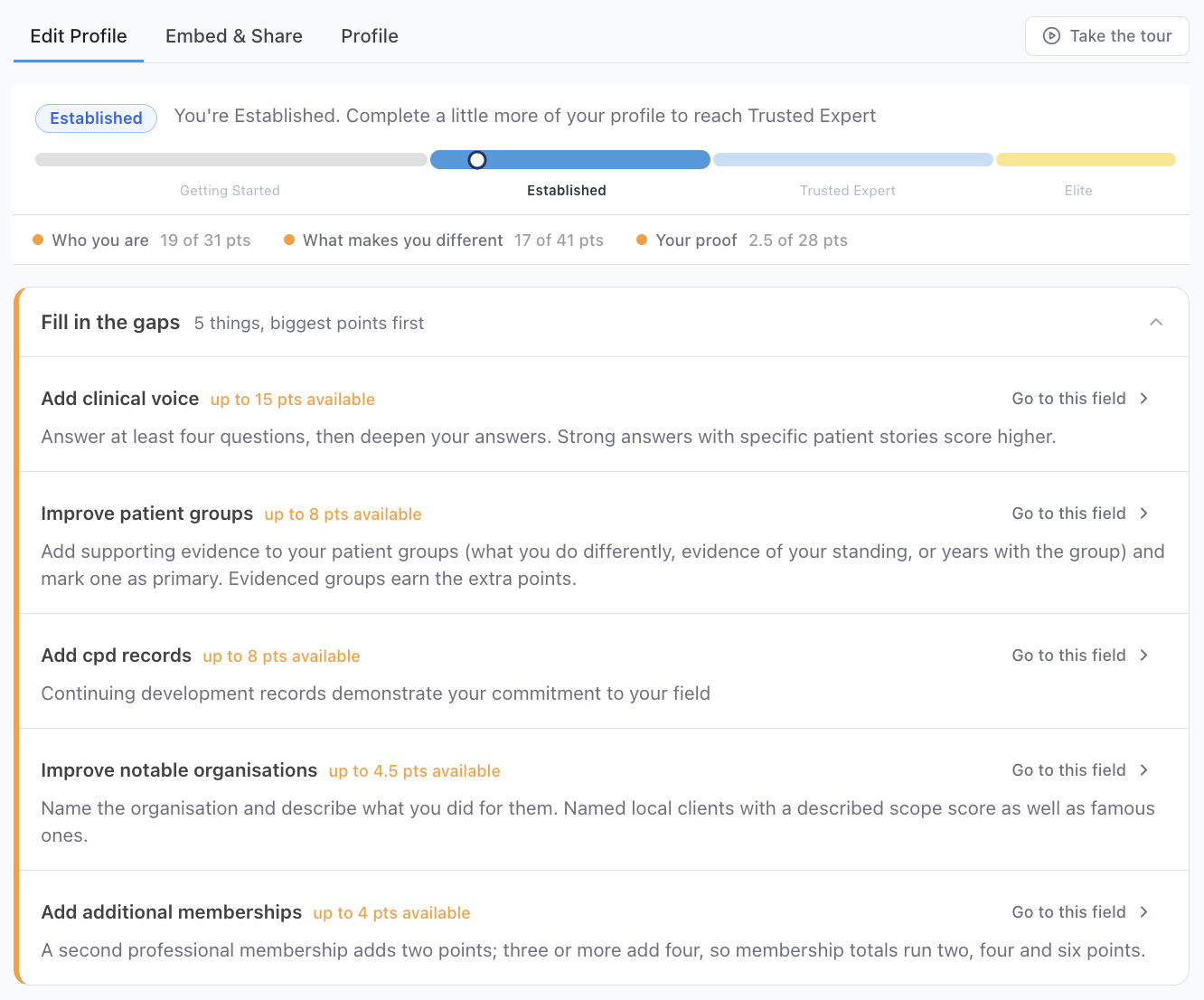
Some quick wins worth knowing about as you go:
- Choose a type for every qualification in Credentials (2 points each, and the most commonly forgotten points on the whole profile).
- Fill in the short depth fields on your conditions and techniques (a sentence each: every filled one adds a bonus point, up to 2 per section).
- Write the Beyond the clinic note (3).
- Add professional memberships (up to 6 for three or more).
- Paste your LinkedIn, blog and YouTube links (up to 9).
- Add a professional photo (2).
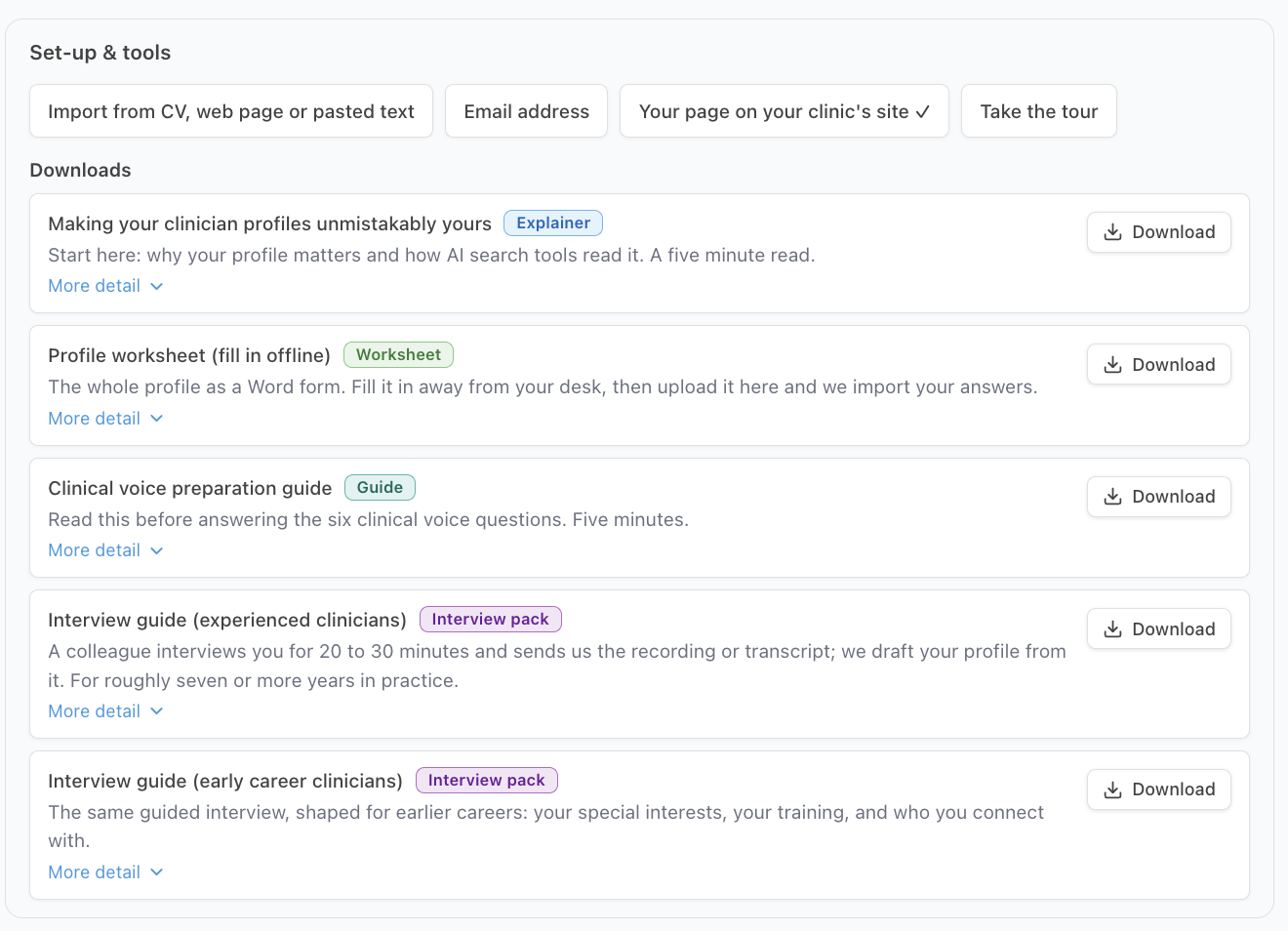
Then tackle the big two: the six clinical voice questions (15 points) and patient groups (12 points). And if you find it easier to talk than to write, don't type at all: the Downloads panel under Set-up and tools has two interview guides (for experienced and early-career clinicians; those links download them directly). Ask a fellow practitioner to interview you for 20 to 30 minutes using the guide, record it, and send us the recording, and we draft the profile from it 🎙️, which usually fills the voice and patient-group sections better than typing ever does. The clinical voice preparation guide in the same panel is a five-minute read with do and don't examples for the six questions.
One reassurance: there are more points available than the cap of 100, so nobody needs a perfect profile. You need 50, or 60 to author ✅.
The question behind the question
"How much does my clinician profile really matter?" Enormously. It is the single most valuable input on the whole platform, because everything we create for you is written from it. And that is exactly what the points measure: each point reflects the value that piece of information brings to the content we write for you, not your professional skill. A brilliant clinician with an empty profile scores low because we have nothing to write from, not because they are anything less than brilliant. The full story of what the profile feeds is in "Why does my clinician's profile matter so much?"
The next question is usually...
- What are niches and primary niches, and how do they shape my plan?
- Is there a faster way to fill in clinician profiles?
- Why does my clinician's profile matter so much?
Still stuck? This usually means...
- You filled things in and the score has not moved. Check the field actually saved, and remember some sections score on substance (a one-word answer to a depth question earns less than a specific one). If a completed section still shows zero, tell us in the chat with the section name.
- A clinician is over 60% and their prompt has gone from the plan. That is deliberate, not a fault. Above the authoring threshold the plan uses what is there rather than pushing for more. You can still keep building the profile, and it is worth it: what is in it decides which of your topics the plan builds first.
- You are close to a threshold and cannot find the last points. Open "Fill in the gaps" again. It re-ranks as you work, so the current biggest win is always at the top.
- Open questions have you frozen. Stop typing and switch to the interview route: the guides in the Downloads panel exist for exactly this moment.